

-
Drive
-
Hotel
-
Feb, Mar, Apr & May
-
Sightseeing
-
All meals during the trek
-
Easy
Pokhara Sightseeing Tour
If you have one day in Pokhara and want to see the city’s main attractions without planning the logistics yourself, this sightseeing tour covers Phewa Lake, the World Peace Pagoda, Davis Falls, Gupteshwor Mahadev Cave, and a selection of other sites in a single organized day. Trek Trove Nepal runs this as a 1-day package at US$65 per person, with private transportation and a guide included.
This page explains what the day actually looks like — the order of stops, how much time you spend at each, what’s included in the US$65, what isn’t, and what to expect from walking, weather, and entrance fees — so you know what you’re booking before you commit to a date.
Quick Facts about Pokhara Tour Package
| Detail | Information |
|---|---|
| Tour Name | Pokhara Sightseeing Tour – 1 Day |
| Location | Pokhara, Gandaki Province |
| Duration | Full day (approx. 7–8 hours) |
| Price | US$65 per person |
| Tour Style | Private vehicle with guide |
| Starting Point | Your hotel in Pokhara |
| Ending Point | Your hotel in Pokhara |
| Walking Involved | Light to moderate (stairs at some sites) |
| Group Size | Private or small group (customizable) |
| Best Season | March–May, September–November |
| Entrance Fees | Not included — paid on-site |
1-Day Pokhara Sightseeing Tour Overview
This tour is built around Pokhara’s core sightseeing circuit: a mix of a lake and temple, a hilltop stupa, a waterfall-and-cave pairing, and a museum, arranged in a practical order to minimize backtracking.
It’s a private-vehicle tour rather than a fixed-departure group bus, so pickup time and pacing can be adjusted within the day. It is not a trek — walking is limited to short stretches and stairs at individual sites, making it accessible to most travelers regardless of fitness level.
Why Choose This Pokhara Sightseeing Tour
- Private transportation, not a shared bus route. You’re not waiting on other travelers or following someone else’s schedule.
- A guide who explains what you’re looking at. Rather than being dropped at a site with no context, your guide provides background on each stop.
- A realistic number of stops for one day. The itinerary is sequenced to avoid rushing between sites or cutting visits short to fit too much in.
- Flexible pickup. Start time is arranged around your hotel location and preference, within reason.
- A practical way to see Pokhara if you’re short on time — useful if you’re passing through before or after a trek, or if Pokhara is one stop on a wider Nepal itinerary.
Why Book with Trek Trove Nepal
Pokhara’s main attractions are spread across the city and its outskirts — Sarangkot and the Peace Pagoda are on opposite sides of the valley from Bindabasini Temple and the museum district — so getting between them efficiently in one day depends on route planning and vehicle availability.
Trek Trove Nepal arranges the vehicle, driver, and guide as a single booking, and can adjust the day’s order if a site is closed, under maintenance, or affected by weather.
Pokhara Sightseeing Tour Full Itinerary
Morning: Hotel Pickup – Phewa Lake – Tal Barahi Temple
Pickup from your hotel in Pokhara. Drive or short walk to Phewa Lake, followed by a boat crossing to Tal Barahi Temple, a Hindu shrine on a small island in the lake. Allow roughly 30–45 minutes for the boat trip and temple visit combined.
Late Morning: World Peace Pagoda
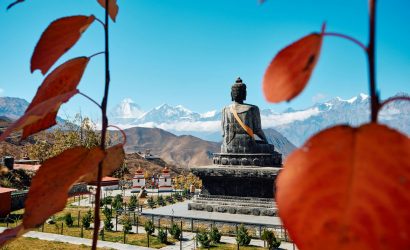
Drive or boat across the lake toward the World Peace Pagoda, a white Buddhist stupa on a hill above Phewa Lake, followed by a walk up to the site. On clear days, the pagoda offers views over the Pokhara valley and toward the Annapurna range. Allow approximately 45 minutes to 1 hour, including the approach.
Midday: Davis Falls and Gupteshwor Mahadev Cave
Drive to Davis Falls, a waterfall where the stream drops into a narrow gorge and partly disappears underground — most dramatic during and just after monsoon season, and comparatively modest outside it.
From there, a short walk across the road to Gupteshwor Mahadev Cave, one of the longer cave systems in Nepal, where the same watercourse can be heard and partly seen underground. Allow roughly 45 minutes to 1 hour for both sites combined.
Afternoon: International Mountain Museum
Visit to the International Mountain Museum, covering the history of Himalayan mountaineering, mountain geography, and the cultures of Nepal’s high-altitude regions. Allow approximately 45 minutes to 1 hour.
Late Afternoon: Bindabasini Temple and Lakeside
Depending on time and traffic, a stop at Bindabasini Temple, a hilltop Hindu temple in the older part of Pokhara, followed by time at Pokhara Lakeside before returning to your hotel.
Evening: Drop-off at Hotel
Return to your hotel in Pokhara, typically by early to mid-evening depending on the day’s pace and starting time.
Places Covered During the Tour
Phewa Lake & Tal Barahi Temple
Phewa Lake is Pokhara’s main lake, with the Annapurna range reflected on the water on clear days. Tal Barahi Temple sits on a small island reached by a short boat crossing and is one of Nepal’s more visited Hindu shrines outside Kathmandu.
World Peace Pagoda
A white Buddhist stupa built by the Nipponzan-Myohoji order, sitting on a hill above the southern side of Phewa Lake. Reaching it typically involves either a boat crossing followed by an uphill walk, or a drive with a shorter walk to the site.
On clear days, it offers a wide view over the lake and city; on overcast or hazy days, mountain visibility is reduced.
Davis Falls
A waterfall (also spelled Devi’s Falls or Devis Falls) where a stream drops into a narrow gorge and vanishes underground. It’s a modest sight outside monsoon season and considerably more dramatic during and just after it (roughly June to September), when water volume is much higher.
Gupteshwor Mahadev Cave
A cave system directly across from Davis Falls, connected to the same underground watercourse. The cave is a Hindu religious site as well as a natural attraction, with lit walkways through sections of the cave. Some paths inside are uneven, damp, or involve steps — comfortable, non-slip footwear is worth wearing.
International Mountain Museum
A museum covering Himalayan mountaineering history, the geography and geology of Nepal’s mountain regions, and the cultures of highland communities. It’s an indoor stop, useful as a change of pace between outdoor sites.
Bindabasini Temple
A Hindu temple on a hill in the older part of Pokhara, dedicated to the goddess Bindabasini. It’s a working temple rather than a tourist site built for visitors, so quiet, respectful behavior is expected.
Pokhara Lakeside
The main tourist strip along the eastern shore of Phewa Lake, with restaurants, cafes, and shops. If time allows toward the end of the day, this is where you’ll have free time before heading back to your hotel.
Tour Route & Transportation
Private vehicle transport is provided for the full day, moving between sites in a sequence designed to minimize doubling back across the city. The Phewa Lake crossings (to Tal Barahi Temple and, depending on route, toward the World Peace Pagoda) are done by boat rather than vehicle.
Approximate Timing / Schedule
| Time Block | Activity | Approx. Duration |
|---|---|---|
| Morning | Hotel pickup, Phewa Lake boat crossing, Tal Barahi Temple | 30–45 min |
| Late morning | World Peace Pagoda | 45 min – 1 hr |
| Midday | Davis Falls & Gupteshwor Cave | 45 min – 1 hr |
| Afternoon | International Mountain Museum | 45 min – 1 hr |
| Late afternoon | Bindabasini Temple & Lakeside (as time allows) | Variable |
| Evening | Return to hotel | — |
Total tour time is approximately 7 to 8 hours, depending on pickup time, traffic, and pace at each stop.
Entrance Fees & Practical Costs
Entrance fees for individual sites are not included in the US$65 package price and are paid directly at each location. Fees are typically modest — the boat crossing to Tal Barahi Temple, Davis Falls, Gupteshwor Cave, and the International Mountain Museum each charge a separate small entry fee, generally in the range of a few hundred Nepali rupees per site.
These amounts can change, so carry small-denomination rupees for the day rather than relying on an exact figure.
Tour Difficulty & Accessibility
This is a sightseeing tour, not a trek, and doesn’t require trekking-level fitness. That said, it isn’t entirely flat: the approach to the World Peace Pagoda involves an uphill walk, Bindabasini Temple sits on a small hill, and Gupteshwor Cave has steps and uneven, sometimes damp sections underground.
Most travelers, including older visitors and families with children, can manage the full itinerary at a normal pace, but anyone with significant mobility limitations should mention this when booking so the itinerary can be adjusted.
Best Time for Pokhara Sightseeing Tour
Autumn (September–November) and spring (March–May) offer the clearest weather and best chance of mountain visibility from the World Peace Pagoda and other viewpoints. Winter (December–February) is generally dry with cool mornings.
Monsoon season (June–August) brings regular rain and increases the chance of overcast skies, though it’s also when Davis Falls is at its most dramatic.
Weather Considerations
Mountain views from the World Peace Pagoda and other elevated points depend entirely on visibility that day — cloud, haze, or rain can obscure the Annapurna range even in the dry season. This is normal for the region and not something any tour operator can guarantee around. Rain during monsoon months can also affect outdoor walking sections and boat crossings.
What to Bring
| Category | Items |
|---|---|
| Clothing | Comfortable walking clothes, layers for temperature changes, modest clothing for temple visits |
| Footwear | Comfortable, non-slip shoes (for cave steps and the Pagoda walk) |
| Weather Gear | Light rain jacket or umbrella (especially June–September), sun hat and sunscreen |
| Cash | Nepali rupees in small denominations for entrance fees and personal spending |
| Other | Camera or phone, reusable water bottle |
Cost Breakdown of Pokhara Tour Package
The US$65 per-person price covers private transportation, a guide, and the full-day itinerary. It does not include entrance fees at individual sites.
| Cost Component | Covered |
|---|---|
| Private vehicle for the day | Yes |
| English-speaking guide | Yes |
| Hotel pickup and drop-off | Yes |
| Boat crossing(s) on Phewa Lake | Depends on booking — confirm at time of booking |
| Site entrance fees | No — paid on-site |
| Meals | No |
Optional Services / Customization
- Add or swap sites (for example, a sunrise stop at Sarangkot, which typically requires an earlier start)
- Extend the day with additional Lakeside time
- Arrange lunch at a specific restaurant along the route
- Combine with a half-day or multi-day itinerary if you’re spending longer in Pokhara
Responsible Tourism
Several stops on this tour are active religious sites — Tal Barahi Temple, Bindabasini Temple, and to some extent Gupteshwor Cave.
Trek Trove Nepal asks travelers to dress modestly, ask before photographing worshippers or ceremonies, and follow any site-specific rules (such as removing shoes before entering certain areas).
Practical Travel Tips
- Carry small-denomination Nepali rupees for entrance fees — card payment isn’t reliably available at these sites.
- If mountain views matter to you, ask about an early start, since visibility is often clearer earlier in the day before cloud builds up.
- Wear shoes with grip for the cave section and the Pagoda approach.
- If you’re visiting during monsoon season, expect Davis Falls to be at its most dramatic but also plan for possible rain during outdoor stops.
- Let your guide know in advance if you have mobility concerns so the day can be paced accordingly.
Book the Pokhara Sightseeing Tour – 1 Day
If you have one day to see Pokhara’s main sights without managing transport, timing, and entrance logistics yourself, this tour covers the city’s core attractions in a practical, unhurried sequence.
Contact Trek Trove Nepal to check availability, confirm your preferred date, and discuss any adjustments to the itinerary for your group.
Pokhara Sightseeing Tour Highlights
- Boat crossing on Phewa Lake to Tal Barahi Temple, a small island shrine
- The World Peace Pagoda, a hilltop Buddhist stupa with views over the Pokhara valley on clear days
- Davis Falls, where a stream drops into a gorge and partly disappears underground
- Gupteshwor Mahadev Cave, connected to the same underground watercourse as Davis Falls
- International Mountain Museum, covering Himalayan mountaineering history and regional geography
- Time at Pokhara Lakeside for a walk, food, or shopping if the schedule allows