
-
Bus, Airlines
-
Home Stay
-
5,416 metres
-
Kathmandu
-
Feb, Mar, Apr & May
-
Eco-Tour, Hiking
-
All meals during the trek
-
English, Spanish, French, Chinese
-
Easy to Moderate
-
2-15
-
12
-
65
Overview
Here’s the full SEO-optimized package for Manaslu Circuit Trek — same detailed structure as the previous packages.
Meta Tags
Title Tag (58 chars): Manaslu Circuit Trek – Remote Himalayan Adventure Guide
Meta Description (155 chars): Trek the Manaslu Circuit around the world’s 8th highest peak. Explore Larkya La Pass, cost, itinerary & permits for the 2026 trek.
H1: Manaslu Circuit Trek
URL Slug: /manaslu-circuit-trek
OG Title: Manaslu Circuit Trek | Around the Eighth Highest Peak
OG Description: Circle Mount Manaslu (8,163m) through remote villages, Tibetan Buddhist culture, and the dramatic Larkya La Pass — Nepal’s rising off-the-beaten-path classic.
Twitter Title: Manaslu Circuit Trek – Nepal’s Remote Restricted-Area Trek
Twitter Description: Trek around Mount Manaslu, the world’s 8th highest peak, crossing Larkya La Pass (5,106m) through remote Tibetan-influenced villages.
Canonical: https://[yourdomain].com/manaslu-circuit-trek
Primary Keyword: Manaslu Circuit Trek
Secondary Keywords: Manaslu trek cost, Manaslu trek itinerary, Manaslu trek permit, Larkya La Pass trek, Manaslu trek difficulty, Manaslu Circuit best season, Manaslu restricted area permit
Introduction
The Manaslu Circuit Trek circles Mount Manaslu (8,163m), the world’s eighth-highest peak, through one of Nepal’s most remote and least commercialized trekking regions. Opened to trekkers only in 1991, the route follows the Budhi Gandaki river valley from lush lower-elevation forests and terraced farmland up into high alpine terrain and Tibetan-influenced villages near the Tibet border, before crossing the demanding Larkya La Pass (5,106m) and descending into the Annapurna region near Dharapani.
Often described as a quieter, more raw alternative to the Everest and Annapurna regions, Manaslu combines serious high-altitude trekking with deep cultural immersion — villages like Samagaon and Samdo reflect a strong Tibetan Buddhist identity, complete with mani walls, chortens, and monasteries. As a restricted area requiring a special permit, it sees a fraction of the foot traffic of Nepal’s more famous circuits, appealing strongly to trekkers seeking authenticity and solitude alongside genuine high-altitude challenge.
Why Trek the Manaslu Circuit?
Around the 8th highest mountain in the world: Up-close views of Manaslu (8,163m) throughout much of the route
Genuinely remote and uncrowded: Restricted-area status keeps visitor numbers far below Everest or Annapurna, offering a quieter, more traditional trekking experience
Rich Tibetan Buddhist culture: Villages like Samagaon and Samdo, near the Tibet border, retain strong Tibetan cultural and religious identity
Larkya La Pass crossing: A dramatic, demanding high pass (5,106m) with panoramic views comparable to Thorong La on the Annapurna Circuit
Diverse landscapes: Subtropical forest at lower elevations transitioning to high alpine terrain and glaciated peaks near the pass
Rising popularity without overcrowding: Increasingly recognized as one of Nepal’s best “next big trek” destinations, still well ahead of mainstream commercialization
Combinable with Tsum Valley: Can be extended into the neighboring Tsum Valley for an even deeper restricted-area cultural experience
Difficulty Level
Overall Rating: Strenuous
The Manaslu Circuit is comparable in difficulty to the Annapurna Circuit and only slightly less demanding than EBC, primarily due to the Larkya La Pass crossing.
Key difficulty factors:
Altitude: Maximum elevation 5,106m at Larkya La Pass — a serious high-altitude crossing
Daily walking hours: 5–7 hours per day, with the pass-crossing day extending to 8–9 hours
Terrain: Varied — river valley trails at lower elevations, steep ascents through forest, and exposed, potentially icy/snowy terrain approaching and crossing Larkya La
Remoteness: Limited teahouse infrastructure and emergency access compared to Everest or Annapurna, requiring more self-sufficiency and a mandatory guide
Pass-day intensity: The Larkya La crossing is a long, cold, high-altitude day with no teahouse directly at the pass — requiring an early start and sustained effort
Recommended fitness preparation:
6–8 weeks of dedicated cardio and endurance training
Practice hikes with a loaded daypack on varied, steep terrain
Prior high-altitude trekking experience strongly recommended given the seriousness of the pass crossing
Who is this trek suitable for?
Trekkers with good fitness and prior high-altitude trekking experience; not recommended as a first Himalayan trek given the remoteness and Larkya La’s demands.
Altitude Sickness & Acclimatization
Manaslu’s altitude profile, culminating in the 5,106m Larkya La crossing, makes careful acclimatization essential — similar in seriousness to the Annapurna Circuit’s Thorong La.
Symptoms to watch for: headache, nausea, dizziness, fatigue disproportionate to exertion, disturbed sleep
Built-in acclimatization: Standard itineraries include a rest day at Samagaon (3,530m) before continuing to Samdo and the pass, following “climb high, sleep low” principles
Ascent rate: Gradual elevation gain is built into the standard 14–18 day itinerary, avoiding rushed ascent profiles
Prevention: Ascend gradually, stay hydrated, avoid alcohol, consider Diamox after consulting a doctor
Remoteness factor: Given limited medical infrastructure along the route, trekkers should carry a comprehensive first-aid kit and ensure travel insurance covers helicopter evacuation from high altitude
Best Seasons to Trek
Autumn (September–November) — Best Overall
Clearest skies and most stable weather for crossing Larkya La Pass; the most popular season for Manaslu, though still far quieter than Everest or Annapurna in the same period.
Spring (March–May) — Excellent
Good visibility, moderate temperatures, blooming rhododendrons at lower elevations. A strong alternative to autumn, particularly for those wanting fewer fellow trekkers.
Winter (December–February) — High Risk Near the Pass
Lower sections remain accessible, but Larkya La Pass frequently becomes difficult or impassable due to heavy snow, and many operators avoid scheduling winter crossings. Not generally recommended for the full circuit.
Monsoon (June–August) — Not Recommended
Heavy rainfall, leeches at lower forested elevations, landslide risk along the Budhi Gandaki valley trail, and poor visibility make this the least suitable season.
Month-by-month quick reference:
Month
Conditions
March–April
Rhododendrons blooming, good visibility
May
Warmer, visibility still strong
June–August
Monsoon rain, landslide risk, leeches
September
Transitional, improving weather
October–November
Peak season, best conditions for Larkya La
December
Cold, pass crossing increasingly risky
January–February
High snow risk, pass often difficult/closed
Cost Breakdown
Item
Estimated Cost (USD)
Notes
Manaslu Restricted Area Permit
$70–100 for first 7 days (Sept–Nov), +$10/day after; lower in off-season (Dec–Aug)
Price varies by season
Manaslu Conservation Area Permit (MCAP)
$30
Required in addition to restricted area permit
Annapurna Conservation Area Permit (ACAP)
$30
Required as the route exits through Annapurna region near Dharapani
Teahouse Accommodation
$8–15/night
Higher than Annapurna/EBC given remoteness
Meals
$20–30/day
Rises with altitude and remoteness
Guide (mandatory)
$30–35/day
Required by law for restricted areas
Porter
$20–25/day
Recommended given trek length
Ground Transport (Kathmandu–Soti Khola and Dharapani–Kathmandu)
$100–150 total
Long, rough mountain roads on both ends
Estimated Total (per person, 14–18 day trek)
$1,400–1,900
Permit costs and mandatory guide requirement drive up total vs. non-restricted treks
Why Manaslu costs more than Annapurna/EBC per day: The restricted area permit and mandatory guide requirement, combined with higher remote-area teahouse pricing, make Manaslu comparably priced to EBC despite lower Lukla-style flight costs.
Group size impact: A minimum of 2 people is required to obtain the Restricted Area Permit; per-person costs decrease with larger groups sharing guide/porter arrangements.
Detailed Itinerary
Day 1: Kathmandu to Soti Khola
7–8 hour drive along rough mountain roads. Overnight in Soti Khola (700m).
Day 2: Soti Khola to Machha Khola
6–7 hours along the Budhi Gandaki river through lower-elevation forest and villages.
Day 3: Machha Khola to Jagat
6–7 hours, entering the restricted area checkpoint at Jagat (1,340m).
Day 4: Jagat to Deng
6–7 hours through deep river gorges and traditional villages.
Day 5: Deng to Namrung
5–6 hours, transitioning into more Tibetan-influenced villages and architecture.
Day 6: Namrung to Samagaon
5–6 hours, first clear views of Manaslu itself, arriving at Samagaon (3,530m).
Day 7: Acclimatization Day in Samagaon
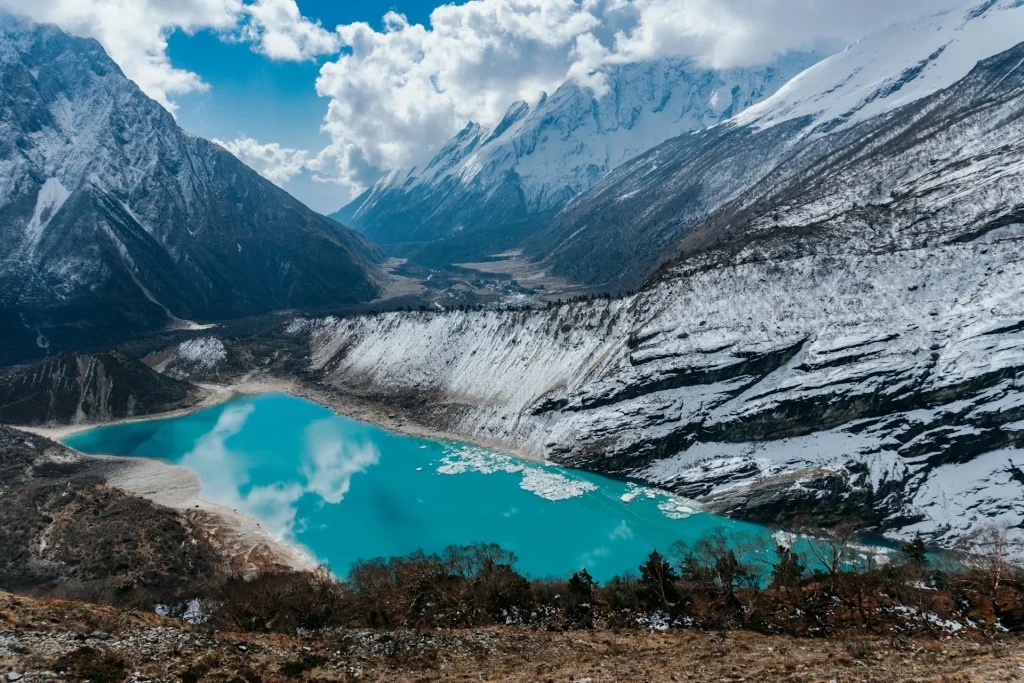
Optional side hike to Manaslu Base Camp or Birendra Lake for altitude adjustment.
Day 8: Samagaon to Samdo
3–4 hours, a shorter day supporting acclimatization, arriving at Samdo (3,875m), the last village before the Tibet border area.
Day 9: Acclimatization/Rest Day in Samdo
Optional hike toward the Tibet border viewpoint.
Day 10: Samdo to Dharamsala/Larkya Phedi
3–4 hours, a short day positioning for the pass crossing, arriving at Dharamsala (4,460m).
Day 11: Dharamsala over Larkya La Pass to Bimthang
8–9 hours, the trek’s most demanding day, crossing Larkya La (5,106m) and descending into Bimthang (3,720m).
Day 12: Bimthang to Dharapani
6–7 hours descending through forest back into the Annapurna region’s Marsyangdi valley.
Day 13: Dharapani to Kathmandu
Long drive (8–9 hours) or a combination of jeep and shorter transfers back to Kathmandu, sometimes via Besisahar.
(Standard itineraries range 14–18 days depending on pace, rest days, and whether extended into Tsum Valley beforehand — the above is a condensed 13-day version; most operators build in additional buffer/acclimatization days.)
Accommodation & Food
Accommodation: Basic teahouses throughout, notably more limited than Annapurna or EBC given the region’s remoteness and restricted-area status. Samagaon and Samdo have the most developed lodging in the upper section. Rooms are simple, often cold, especially approaching the pass.
Food: Standard teahouse fare (dal bhat, noodles, soups, Tibetan bread), with prices rising substantially in the upper villages due to the lack of road access. Fewer menu options than Annapurna or EBC routes, particularly above Namrung.
Permits Required
Manaslu Restricted Area Permit – $70–100 for the first 7 days (September–November season), plus $10/person/day beyond that; lower rates apply December–August. Requires a minimum group of 2 and a licensed guide/registered agency
Manaslu Conservation Area Permit (MCAP) – $30 per person
Annapurna Conservation Area Permit (ACAP) – $30 per person, required as the route exits into the Annapurna region near Dharapani
Important note for clients: Like Upper Mustang, Manaslu cannot be trekked independently — a licensed guide and registered trekking agency are legally required to obtain the Restricted Area Permit.
Packing List
Clothing
Moisture-wicking base layers
Fleece or insulated mid-layer
Waterproof, windproof outer shell jacket
Heavyweight down jacket (essential for Larkya La crossing)
Insulated trekking trousers + warm layer for evenings
Warm hat, sun hat, gloves (liner + insulated/mitten combo for pass day)
Wool or synthetic hiking socks (multiple pairs)
Buff/neck gaiter
Footwear
Sturdy, waterproof, broken-in trekking boots
Gaiters (recommended for snow near the pass)
Camp shoes for evenings
Gear
Sleeping bag rated to -15°C or lower
Trekking poles (essential for the pass crossing)
Headlamp with spare batteries
Daypack (30–35L) with rain cover
Duffel bag for porter
Health & Safety
Comprehensive first-aid kit including altitude sickness medication
Water purification tablets or filter
High-SPF sunscreen and lip balm
Personal medications
Pulse oximeter recommended given remoteness and altitude
Miscellaneous
Power bank(s) — charging limited and paid in upper villages
Reusable water bottle
Cash in Nepali Rupees (no ATMs beyond Kathmandu departure)
Travel insurance documents with helicopter evacuation coverage
Cultural Significance
The upper Manaslu region, particularly around Samagaon and Samdo, is home to communities of Tibetan origin whose culture, language, and Buddhist religious practice closely mirror those across the nearby Tibet border. Villages feature prominent mani walls, chortens, and monasteries, with Pungyen Gompa, a monastery near Samagaon associated with local guardian deity traditions, being a notable side-trip destination for trekkers wanting deeper cultural engagement.
Mount Manaslu itself, whose name derives from the Sanskrit “manasa” (meaning “soul” or “intellect”), holds spiritual significance locally and was first summited in 1956 by a Japanese expedition — leading to its longstanding nickname as “Japan’s Mountain” within the global mountaineering community due to the strong historical ties between Japanese climbers and the peak.
Manaslu Circuit vs. Other Restricted/Remote Treks in Nepal
Trek
Duration
Max Altitude
Difficulty
Permit Type
Manaslu Circuit Trek
14–18 days
5,106m (Larkya La)
Strenuous
Restricted Area Permit + MCAP + ACAP
Upper Mustang Trek
10–12 days
3,840m
Moderate
Restricted Area Permit + ACAP
Tsum Valley Trek
14–18 days
3,700m
Moderate–Strenuous
Restricted Area Permit
Annapurna Circuit
15–20 days
5,416m (Thorong La)
Strenuous
ACAP + TIMS
Everest Base Camp Trek
12–14 days
5,364m
Strenuous
Sagarmatha permit + Khumbu permit
Manaslu is often positioned as the closest equivalent to the Annapurna Circuit’s difficulty and pass-crossing drama, but with a fraction of the crowds due to its restricted-area status — appealing strongly to repeat Nepal trekkers seeking a less commercialized high-altitude experience.
FAQs
Q: How difficult is the Manaslu Circuit Trek?
A: Rated strenuous, comparable to the Annapurna Circuit, primarily due to the Larkya La Pass crossing at 5,106m.
Q: Is a guide mandatory for the Manaslu Circuit?
A: Yes. As a restricted area, a licensed guide and registered trekking agency are legally required to obtain the necessary permits.
Q: How many days does the Manaslu Circuit take?
A: Standard itineraries run 14–18 days, including acclimatization days and the Larkya La Pass crossing.
Q: What permits are required for Manaslu?
A: The Manaslu Restricted Area Permit, Manaslu Conservation Area Permit (MCAP), and Annapurna Conservation Area Permit (ACAP), as the route exits through the Annapurna region.
Q: When is the best time to trek the Manaslu Circuit?
A: September to November offers the most stable conditions for the Larkya La Pass crossing; March to May is a strong secondary option.
Q: How does Manaslu compare to the Annapurna Circuit?
A: Similar difficulty and pass altitude, but Manaslu sees far fewer trekkers due to its restricted-area status, offering a quieter, more remote experience.
Q: Can Manaslu be combined with Tsum Valley?
A: Yes, many itineraries extend into the neighboring Tsum Valley before rejoining the main Manaslu Circuit route, for a longer, deeper restricted-area experience.
Q: Is prior trekking experience necessary for Manaslu?
A: Strongly recommended given the seriousness of the Larkya La Pass crossing and the route’s remoteness; not ideal as a first Himalayan trek.
Highlights
- Trek to the world-famous Everest Base Camp
- Enjoy the amazing view of the Himalayas from Kala Patthar
- Travel through the Sherpa villages of Namche, Khumjung, Khunde, and Dingboche
- Visit Tengboche the biggest and oldest monastery n the region.