
-
Drive, Flight
-
Lodge, Teahouse
-
4,130 meters
-
Kathmandu
-
Spring, Autumn
-
Peak Climbing, Trekking
-
BLD
-
Hard
-
2-20
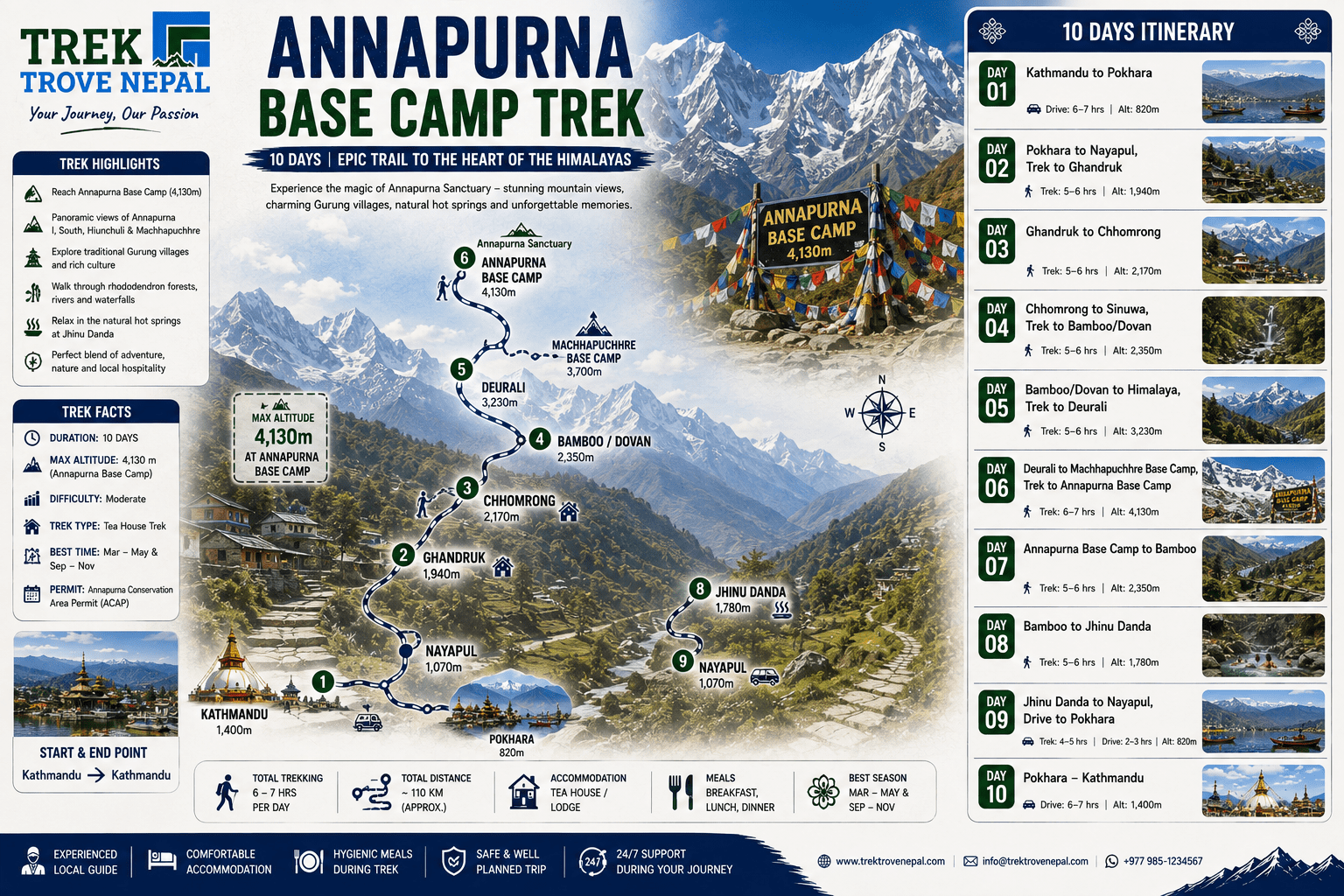
Annapurna Base Camp sits at approximately 4,130 meters inside the Annapurna Sanctuary, a glacial basin ringed by Annapurna I, Annapurna South, Hiunchuli, and Machhapuchhre. This 10-day itinerary covers the full route from Kathmandu and Pokhara through Ghandruk and Chhomrong to reach it, with enough days built in to manage the altitude gain properly rather than rushing it.
Trek Trove Nepal runs this as a 10-day package at US$550 per person, including permits, guide, accommodation, and meals during the trek.
This page sets out the actual daily walking, the altitude profile day by day, the stair sections and steep terrain that define this trek, and what the US$550 price covers — so you know what the trek genuinely involves before you book.
Quick Facts
| Detail | Information |
|---|---|
| Trip Name | Annapurna Base Camp Trek – 10 Days |
| Region | Annapurna Conservation Area, Annapurna Region |
| Duration | 10 Days |
| Price | US$550 per person |
| Trek Style | Tea house trek |
| Starting Point | Kathmandu / Pokhara (drive to Nayapul) |
| Ending Point | Pokhara / Kathmandu |
| Maximum Altitude | Annapurna Base Camp, approx. 4,130 m |
| Difficulty | Moderate to challenging |
| Group Size | Private or small group (customizable) |
| Best Season | March–May, September–November |
| Permits Required | ACAP, TIMS |
| Accommodation | Tea houses / lodges |
| Meals | Breakfast, lunch, dinner during trek |
10-Day Annapurna Base Camp Trek Overview
This itinerary starts in Kathmandu, transfers to Pokhara, then treks in via Ghandruk and Chhomrong — the standard tea house route into the Annapurna Sanctuary — reaching ABC around Day 6 before descending via Jhinu Danda. Ten days is enough to cover this route at a sustainable pace: gradual altitude gain on the way up, a night at Machhapuchhre Base Camp or a direct push to ABC depending on pacing, and a return that isn’t rushed.
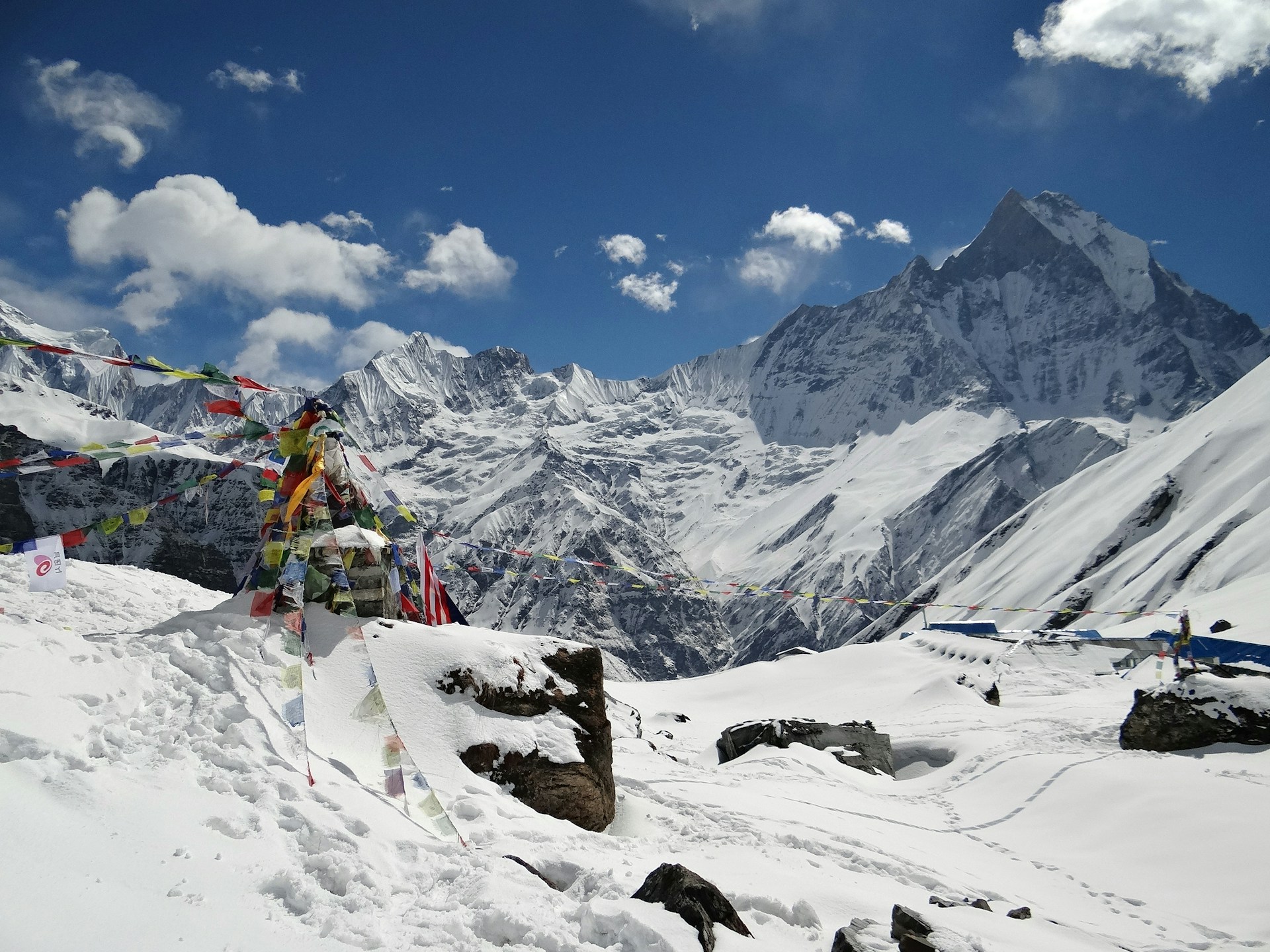
The trail moves through noticeably different terrain as it climbs — terraced farmland and Gurung villages lower down, giving way to bamboo and rhododendron forest, then the open, rocky terrain of the Sanctuary itself above Deurali.
Why Choose the Annapurna Base Camp Trek
- A genuine high-altitude destination without Everest Base Camp’s time or cost commitment. ABC reaches over 4,000 meters in roughly 10 days total, compared to the 12–14+ days most EBC itineraries need.
- The Annapurna Sanctuary itself is the destination, not just a viewpoint. You walk into a glacial amphitheater ringed by four named peaks, a distinct geographic feature rather than a single mountain view.
- A well-established tea house route. Infrastructure along this trail — lodges, food, connectivity — is more developed than on more remote routes, which matters for comfort at altitude.
- Cultural depth on the way up. Ghandruk and the lower villages are established Gurung settlements, giving the trek cultural substance before the terrain becomes purely alpine.
- Ten days allows real acclimatization. Compared to compressed 7-day ABC itineraries, this pacing reduces (though doesn’t eliminate) altitude-related risk.
Why Book with Trek Trove Nepal
The Annapurna Sanctuary’s altitude gain is real, and pacing matters — Trek Trove Nepal’s guides are experienced with this specific route’s acclimatization pattern and adjust the day’s pace if anyone in the group shows symptoms.
Permits, tea house bookings along a route that gets busy in peak season, and Kathmandu–Pokhara transport are all arranged as part of this package.
10-Days Annapurna Base Camp Trek Itinerary Overview
Day 1: Kathmandu – Pokhara
Drive or flight from Kathmandu to Pokhara. Overnight in Pokhara.
Day 2: Pokhara – Nayapul – Ghandruk
Drive from Pokhara to Nayapul (approx. 1 to 1.5 hours), then trek via Birethanti to Ghandruk (approx. 1,940 m). Walking time is approximately 5 to 6 hours on stone-paved trail with sustained uphill sections. Overnight in Ghandruk.
Day 3: Ghandruk – Chhomrong
Trek from Ghandruk to Chhomrong (approx. 2,170 m), descending into and back out of the Kimrong Khola valley. Walking time is approximately 5 to 6 hours, with a mix of downhill and uphill stone-step sections. Chhomrong is the last large permanent village before the trail enters more remote terrain.
Day 4: Chhomrong – Sinuwa – Bamboo/Dovan
Descend steeply from Chhomrong via a long stone staircase, cross the Chhomrong Khola, then climb to Sinuwa before continuing through bamboo and rhododendron forest to Bamboo or Dovan (approx. 2,310–2,600 m). Walking time is approximately 5 to 6 hours.
Day 5: Bamboo/Dovan – Himalaya – Deurali
Continue climbing through forest that thins with altitude, passing Himalaya village, to Deurali (approx. 3,230 m). Walking time is approximately 5 to 6 hours. The vegetation noticeably thins by this point, marking the approach to the Sanctuary.
Day 6: Deurali – Machhapuchhre Base Camp – Annapurna Base Camp
Trek through the final approach into the Annapurna Sanctuary, passing Machhapuchhre Base Camp (approx. 3,700 m) before continuing to Annapurna Base Camp (approx. 4,130 m). Walking time is approximately 5 to 6 hours. This is the trek’s highest and most altitude-sensitive day. Overnight at ABC.
Day 7: Annapurna Base Camp – Bamboo
Descend from ABC back through Deurali and Himalaya to Bamboo. Walking time is approximately 6 to 7 hours — a long descending day covering ground that took two days on the way up.
Day 8: Bamboo – Jhinu Danda
Descend and cross back toward Chhomrong, then down to Jhinu Danda (approx. 1,780 m), known for its natural hot spring near the Modi Khola. Walking time is approximately 5 to 6 hours. Overnight in Jhinu Danda, with time to visit the hot spring.
Day 9: Jhinu Danda – Nayapul – Pokhara
Descend from Jhinu Danda to Nayapul (approx. 3 to 4 hours walking), then drive back to Pokhara. Overnight in Pokhara.
Day 10: Pokhara – Kathmandu
Drive or flight back to Kathmandu, ending the trek.
Route Overview
Kathmandu → Pokhara → Nayapul → Ghandruk → Chhomrong → Sinuwa → Bamboo/Dovan → Himalaya → Deurali → Machhapuchhre Base Camp → Annapurna Base Camp → (return via same route) → Jhinu Danda → Nayapul → Pokhara → Kathmandu
Daily Walking Distance & Hours
| Day | Route | Walking Time |
|---|---|---|
| 1 | Kathmandu → Pokhara (drive) | — |
| 2 | Nayapul → Ghandruk | 5–6 hrs |
| 3 | Ghandruk → Chhomrong | 5–6 hrs |
| 4 | Chhomrong → Bamboo/Dovan | 5–6 hrs |
| 5 | Bamboo/Dovan → Deurali | 5–6 hrs |
| 6 | Deurali → MBC → Annapurna Base Camp | 5–6 hrs |
| 7 | Annapurna Base Camp → Bamboo | 6–7 hrs |
| 8 | Bamboo → Jhinu Danda | 5–6 hrs |
| 9 | Jhinu Danda → Nayapul → Pokhara | 3–4 hrs walk + drive |
| 10 | Pokhara → Kathmandu (drive) | — |
Altitude Profile
| Location | Approximate Altitude |
|---|---|
| Kathmandu | 1,400 m |
| Pokhara | 822 m |
| Nayapul | ~1,070 m |
| Ghandruk | ~1,940 m |
| Chhomrong | ~2,170 m |
| Bamboo/Dovan | ~2,310–2,600 m |
| Deurali | ~3,230 m |
| Machhapuchhre Base Camp | ~3,700 m |
| Annapurna Base Camp (highest point) | ~4,130 m |
The route gains roughly 3,300 meters from Nayapul to ABC over five trekking days, then loses most of it again over the following three — a substantial elevation swing for a 10-day trip, which is part of why pacing matters as much as it does on this route.
Annapurna Base Camp Experience
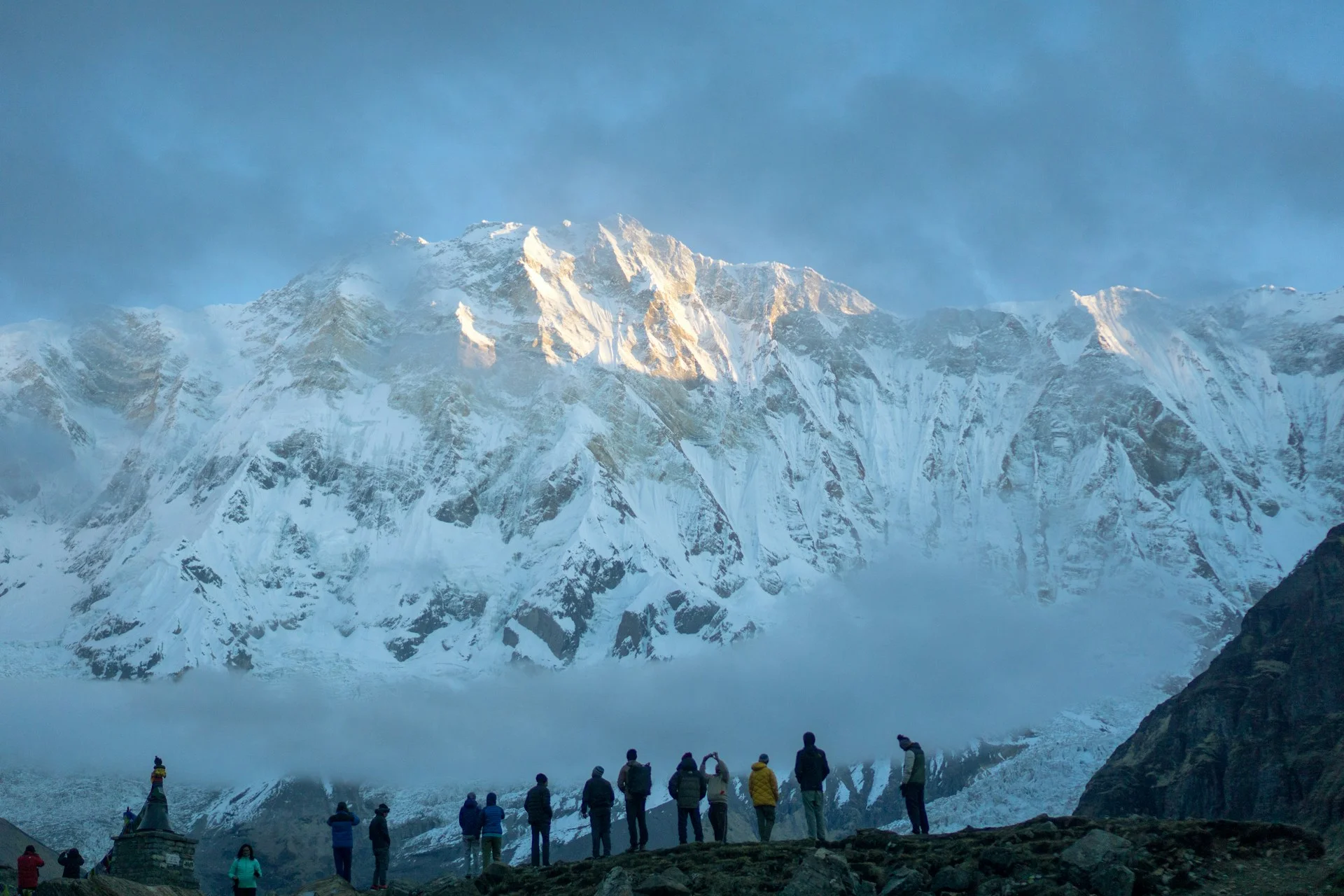
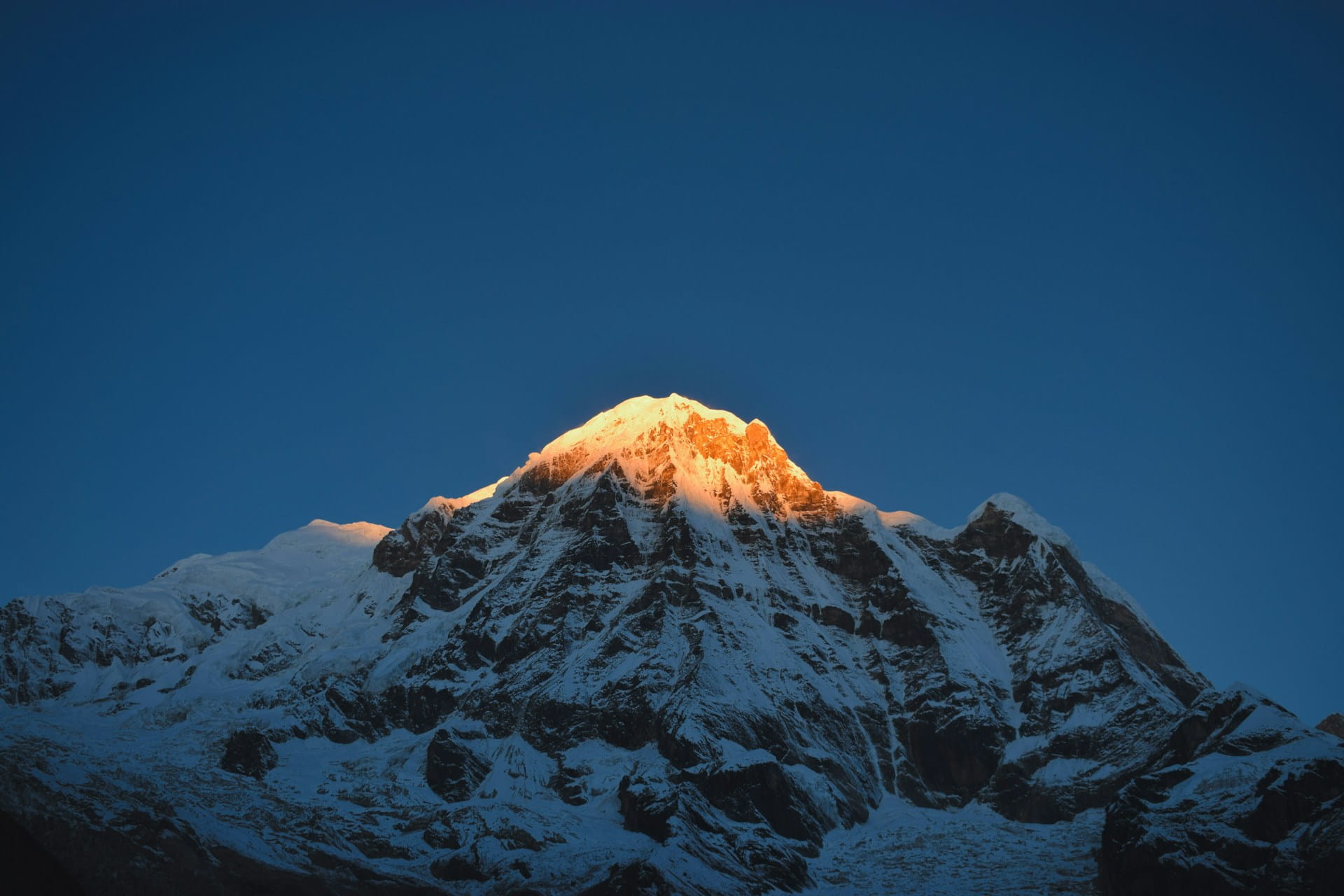
Annapurna Base Camp sits inside the Annapurna Sanctuary, a glacial basin enclosed by a ring of peaks — Annapurna I, Annapurna South, Hiunchuli, and Machhapuchhre all rise directly around the site. Unlike a single-viewpoint destination, ABC puts you inside a mountain amphitheater, with peaks visible in multiple directions rather than one horizon line.
The base camp itself has tea house accommodation, meaning most trekkers spend a night here rather than a brief visit-and-descend. Mornings tend to offer the clearest views before cloud typically builds through the day — this is standard mountain weather behavior in the region, not something any fixed itinerary can guarantee around.
Machhapuchhre Base Camp
Machhapuchhre Base Camp (MBC), at approximately 3,700 m, is the last stop before ABC and sits close enough to Machhapuchhre (Fishtail Mountain) to offer a notably close-range view of the peak.
Machhapuchhre itself has never been officially climbed and remains closed to summit attempts — MBC is a viewing and trekking waypoint, not a climbing base camp in the mountaineering sense.
Annapurna Sanctuary
The Annapurna Sanctuary is the glacial basin that ABC sits within — a geographic bowl enclosed by the Annapurna and Machhapuchhre massifs, accessible only through the narrow gorge the trail follows near Machhapuchhre Base Camp and Hinku Cave.
This geography is part of why the final approach to ABC feels distinct from the rest of the trek — you’re walking into an enclosed high-altitude basin rather than along an open ridge or valley.
Mountain Views
On clear days, the peaks visible from ABC and the approach include Annapurna I (8,091 m), Annapurna South, Hiunchuli, and Machhapuchhre. Visibility is typically best in the early morning; afternoon cloud buildup is common in the Annapurna region, particularly outside the driest months.
Cloud cover, haze, or precipitation can reduce or eliminate mountain visibility on any given day — this applies to every departure date and isn’t something any operator can guarantee against.
Gurung and Magar Culture
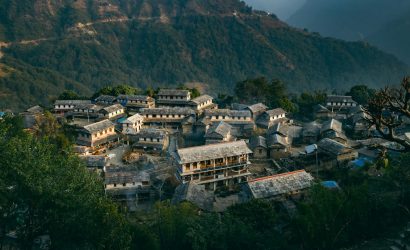
Ghandruk and other lower villages on this route are established Gurung settlements, with traditional stone architecture, terraced farmland, and lodges typically run by local families. Magar communities are also present in parts of the wider Annapurna region.
As you climb past Chhomrong, permanent settlement thins out — the villages above are largely tea house infrastructure built to serve trekkers rather than year-round agricultural communities, which is a notable shift in character partway through the trek.
Annapurna Conservation Area
This entire route runs within the Annapurna Conservation Area (ACA), Nepal’s largest protected area, managed under a permit system that funds conservation and community development in the region. The ACAP permit fee, along with your TIMS card, is what allows legal trekking access to this route.
Trek Difficulty
The Annapurna Base Camp Trek is rated moderate to challenging. The trail is a well-established tea house route without technical climbing, but it involves consistent stone-step ascents and descents — the Chhomrong staircase in particular is a well-known, sustained set of steps in both directions.
Daily walking of 5 to 7 hours over multiple consecutive days, combined with altitude gain reaching over 4,000 meters, makes this considerably more demanding than a short low-altitude trek, even though no single day requires technical skill.
Fitness Requirements
Good baseline cardiovascular fitness is recommended — being able to walk 5 to 7 hours a day on hilly, stepped terrain across multiple consecutive days.
Prior trekking experience helps but isn’t required; reasonably fit beginners regularly complete this trek, particularly with the acclimatization built into a 10-day pace.
Altitude & Acclimatization
Altitude is the central factor in this trek’s difficulty, not just the walking distance. Gaining from around 1,070 m at Nayapul to 4,130 m at ABC over five trekking days is a substantial rate of ascent, and mild symptoms — headache, fatigue, reduced appetite — are common even in fit trekkers as you approach 3,500–4,000 m.
This itinerary’s pacing, particularly the days through Deurali and MBC before reaching ABC, is built to allow gradual adjustment, but altitude sickness cannot be ruled out by fitness or pacing alone. Walking at a steady pace, staying well hydrated, and telling your guide immediately about any symptoms are standard, sensible precautions.
If symptoms become more than mild, descending is the appropriate response, and your guide will make that call if necessary. Travel insurance covering high-altitude trekking and emergency evacuation is strongly recommended.
Trail Conditions
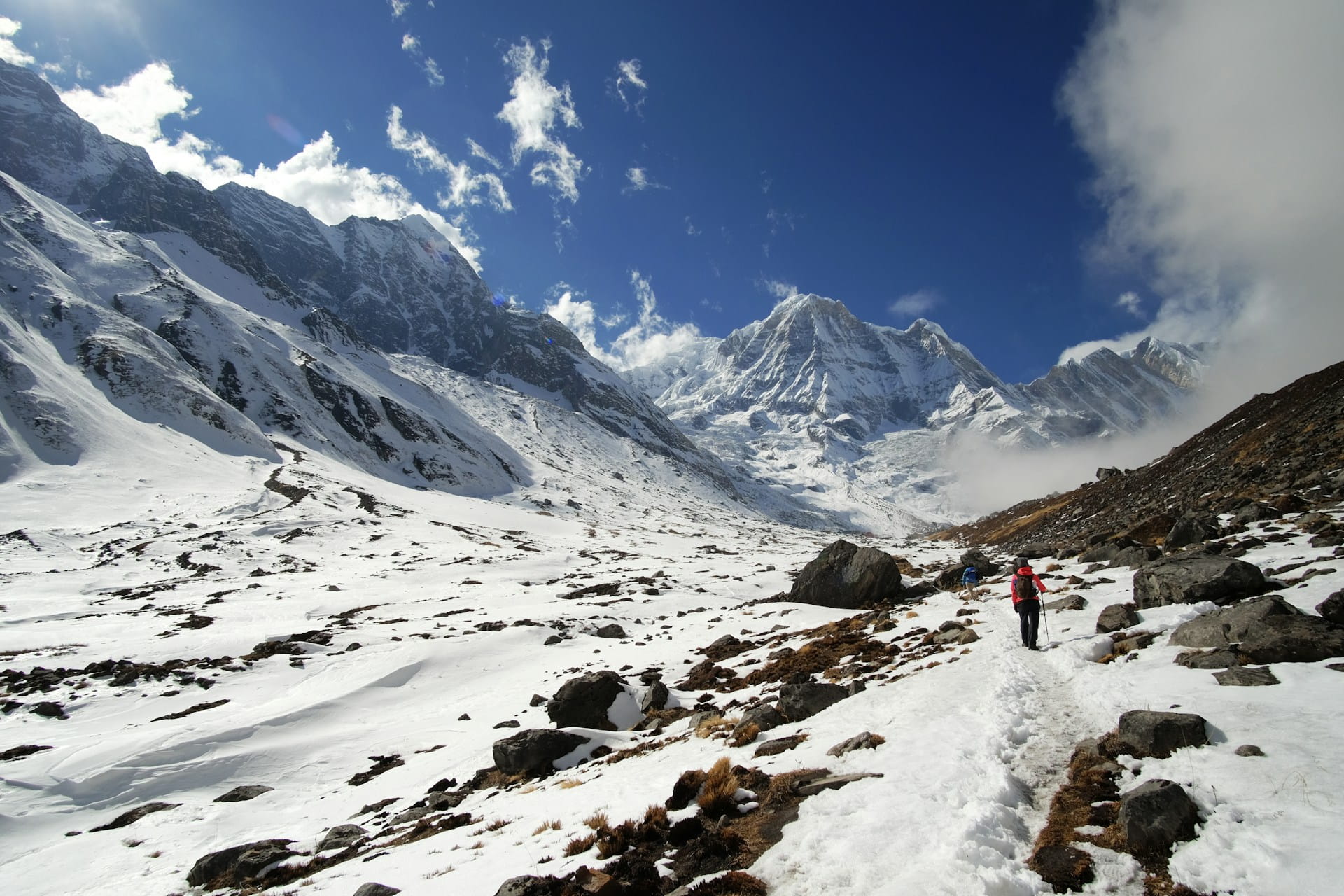
Expect stone-paved and stepped trail for most of the route, river crossings on suspension bridges, forest sections (bamboo, rhododendron, oak) through the middle days, and increasingly open, rocky terrain above Deurali.
Outside the main trekking seasons, snow and ice are possible on the higher sections near MBC and ABC, which affects footing and may require extra caution or, in some conditions, trekking poles and appropriate footwear.
Best Time to Trek
Season Comparison
| Season | Months | Conditions |
|---|---|---|
| Spring | March – May | Warm at lower elevations, cold at ABC, rhododendron blooming at mid-altitude, generally good visibility |
| Summer/Monsoon | June – August | Frequent rain, leeches on lower forested sections, cloud regularly obscures mountain views |
| Autumn | September – November | Most reliable season — stable weather, clear skies, good mountain visibility |
| Winter | December – February | Cold, with snow likely near MBC and ABC; some tea houses may have reduced services |
Weather Overview
Temperature swings are significant across this route given the elevation range from Pokhara (822 m) to ABC (4,130 m). Autumn offers the most dependable combination of clear skies and manageable cold at altitude. Spring is generally good with more afternoon cloud than autumn.
Winter brings a real chance of snow near MBC and ABC, which can affect trail conditions — worth discussing with Trek Trove Nepal if considering a winter departure. Monsoon season brings consistent rain, leeches on the lower forested sections, and reduced mountain visibility.
Transportation from Kathmandu/Pokhara
The trek begins with transport from Kathmandu to Pokhara (by road or domestic flight, confirm at booking), then a private or shared vehicle from Pokhara to Nayapul (roughly 1 to 1.5 hours), where the trekking begins. The return follows the same route in reverse.
Accommodation
Accommodation is in tea houses/lodges throughout, generally on a twin-sharing basis. Facilities are more developed at lower elevations (Ghandruk, Chhomrong) and progressively more basic higher up, particularly at MBC and ABC, where cold nights and limited hot water are standard for the altitude and remoteness.
| Night | Location | Accommodation Type |
|---|---|---|
| Night 1 | Pokhara | Hotel |
| Night 2 | Ghandruk | Tea house, twin-share |
| Night 3 | Chhomrong | Tea house, twin-share |
| Night 4 | Bamboo/Dovan | Tea house, twin-share |
| Night 5 | Deurali | Tea house, twin-share |
| Night 6 | Annapurna Base Camp | Tea house, twin-share (basic) |
| Night 7 | Bamboo | Tea house, twin-share |
| Night 8 | Jhinu Danda | Tea house, twin-share |
| Night 9 | Pokhara | Hotel |
Meals & Drinking Water
Breakfast, lunch, and dinner are included during the trekking days, served at the tea houses along the route. Menus typically include Nepali dal bhat, noodle and rice dishes, soups, and simple Western options; choices become more limited at higher elevations like ABC.
Bottled and boiled water are available for purchase at tea houses; a reusable bottle with purification tablets or a filter is a practical, lower-cost alternative over a 10-day trek.
Wi-Fi, Electricity and Connectivity
Most tea houses along this route offer Wi-Fi and device charging, typically for a small additional fee, with reliability decreasing at higher elevations, particularly at MBC and ABC where connections can be slow or intermittent. Don’t rely on consistent connectivity above Chhomrong — a power bank is a practical backup for charging.
Permits and Trekking Requirements
Two documents are required for this trek:
- ACAP (Annapurna Conservation Area Permit) — required since the entire route runs within the Annapurna Conservation Area.
- TIMS Card (Trekkers’ Information Management System) — a standard trekking registration document.
Trek Trove Nepal arranges both as part of the package. You’ll need your passport details and passport-sized photos in advance.
Packing Checklist
| Category | Items |
|---|---|
| Clothing | Base layers, warm insulated jacket (down or synthetic), waterproof/windproof shell, trekking trousers, warm hat, gloves |
| Footwear | Broken-in, well-supporting hiking boots, warm socks, gaiters useful in shoulder-season snow |
| Gear | Daypack, trekking poles (recommended for the stone steps and steep sections), headlamp with spare batteries, reusable water bottle |
| Health | Personal first aid kit, sunscreen, sunglasses (UV exposure increases with altitude), any personal medication |
| Documents | Passport, passport photos, travel insurance details covering high-altitude trekking and evacuation |
| Extras | Power bank, cash in Nepali rupees, basic toiletries |
Cost Breakdown
The US$550 per-person price covers a 10-day itinerary with permits, guide, transport, accommodation, and meals during the trek.
| Cost Component | Covered |
|---|---|
| ACAP + TIMS permit fees | Yes |
| Guide (English-speaking) | Yes |
| Ground transport Pokhara–Nayapul (return) | Yes |
| Accommodation (9 nights: tea houses + Pokhara hotel) | Yes |
| Meals during trek (B, L, D) | Yes |
| Kathmandu–Pokhara transport | Confirm at booking |
| Porter | Available on request, additional cost |
Optional Services / Customization
- Porter service for luggage
- Extra acclimatization or buffer days
- Combination with Ghorepani–Poon Hill for an extended itinerary
- Extra nights in Pokhara before or after the trek
Responsible Trekking
This route passes through the Annapurna Conservation Area, and permit fees contribute to conservation and community development in the region.
Trek Trove Nepal asks trekkers to stay on marked trails, dispose of waste properly (carry out what you carry in where tea house bins aren’t available), and support local lodges and shops along the route.
Practical Travel Tips
- Pace yourself deliberately above Chhomrong — rushing the altitude gain increases the risk of symptoms.
- Bring trekking poles; the stone-step sections, particularly around Chhomrong, are demanding on both ascent and descent.
- Carry more cash than you expect — ATMs are unreliable past Pokhara.
- Pack a warm layer for ABC and MBC even in the warmer trekking seasons — nights are cold regardless of season at this altitude.
- Confirm your departure date a few days ahead so permits can be processed.
Book the Annapurna Base Camp Trek
If you want a real high-altitude trekking experience — the Annapurna Sanctuary, a mountain amphitheater at over 4,000 meters, and genuine cultural depth on the way up — this 10-day itinerary is built to get you there and back at a sustainable pace.
Contact Trek Trove Nepal to check availability, confirm departure dates, and discuss your fitness level and any adjustments to the itinerary.
Annapurna Base Camp Trek Highlights
- Standing inside the Annapurna Sanctuary itself. ABC isn't a single viewpoint — it's a glacial basin enclosed by Annapurna I, Annapurna South, Hiunchuli, and Machhapuchhre, so you get mountains in multiple directions rather than one horizon line.
- A genuine altitude achievement in 10 days. Gaining roughly 3,300 m from Nayapul to ABC over five trekking days, then descending most of it in three, is a real physical accomplishment without needing the 12–14+ days Everest Base Camp requires.
- Two distinct Gurung villages on the way up. Ghandruk and Chhomrong each have their own character and traditional architecture — this route treats them as real overnight stops, not just names on a map.
- The Chhomrong staircase. A specific, well-known sustained stone-step section that trekkers deal with in both directions — a concrete example of what "stone steps" actually means on this trail, not a vague difficulty label.
- A visible shift in landscape as you climb. Terraced farmland gives way to bamboo and rhododendron forest, then thins into the open, rocky terrain of the Sanctuary above Deurali — four distinct environments in a single trek.
- Machhapuchhre Base Camp's close-range Fishtail view. The last stop before ABC puts you nearer to Machhapuchhre than almost anywhere else on the route, worth noting as its own moment rather than folding it into the ABC arrival.
- Jhinu Danda's natural hot spring on the way down — a genuine, practical rest point after several days of descent, not a manufactured amenity.
- A pace built for acclimatization, not just distance. The 10-day structure specifically allows gradual adjustment to altitude, which is the actual limiting factor on this trek — a detail that matters more here than trail difficulty alone.