
-
Hotel
-
Kathmandu
-
Spring, Autumn
-
3,800 m
-
BLD
-
Drive
Muktinath Tour Nepal Overview
Muktinath sits at roughly 3,800 meters in the Mustang district of Nepal, inside the Annapurna Conservation Area. It is one of the few pilgrimage sites in the world recognized as sacred by both Hindus and Buddhists, and one of the most accessible high-altitude temples in Nepal — reachable by jeep rather than requiring a multi-day trek.
This 7-day Muktinath Tour Nepal package takes you from Kathmandu to Pokhara, then along the Kali Gandaki Valley through Jomsom and Kagbeni to Muktinath Temple, before returning the same route. The itinerary is built around road travel logistics, altitude, and the practical realities of visiting a high-altitude pilgrimage site — not just the temple visit itself.
Nepal Muktinath Tour Quick Facts Table
| Detail | Information |
|---|---|
| Tour Name | Muktinath Tour Nepal |
| Duration | 7 Days / 6 Nights |
| Starting Point | Kathmandu |
| Ending Point | Kathmandu |
| Maximum Altitude | Approx. 3,800 m (Muktinath) |
| Region | Mustang, Annapurna Conservation Area |
| Tour Type | Pilgrimage / Cultural Jeep Tour |
| Transportation | Private vehicle, jeep, optional domestic flight |
| Accommodation | Guesthouses and 2–3 star hotels |
| Group Size | Private or small group (customizable) |
| Best Season | March–May and September–November |
| Difficulty | Moderate (altitude and road conditions) |
Muktinath Tour Nepal
The route follows the Kali Gandaki River valley, one of the deepest gorges in the world, running between the Annapurna and Dhaulagiri massifs. The tour begins with a scenic drive or flight from Kathmandu to Pokhara, then continues north into Mustang district by jeep on a mountain road that climbs steadily in altitude.
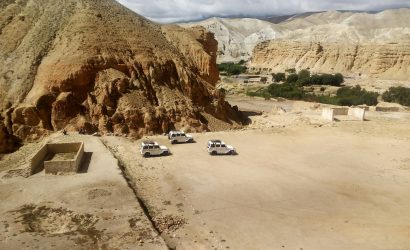
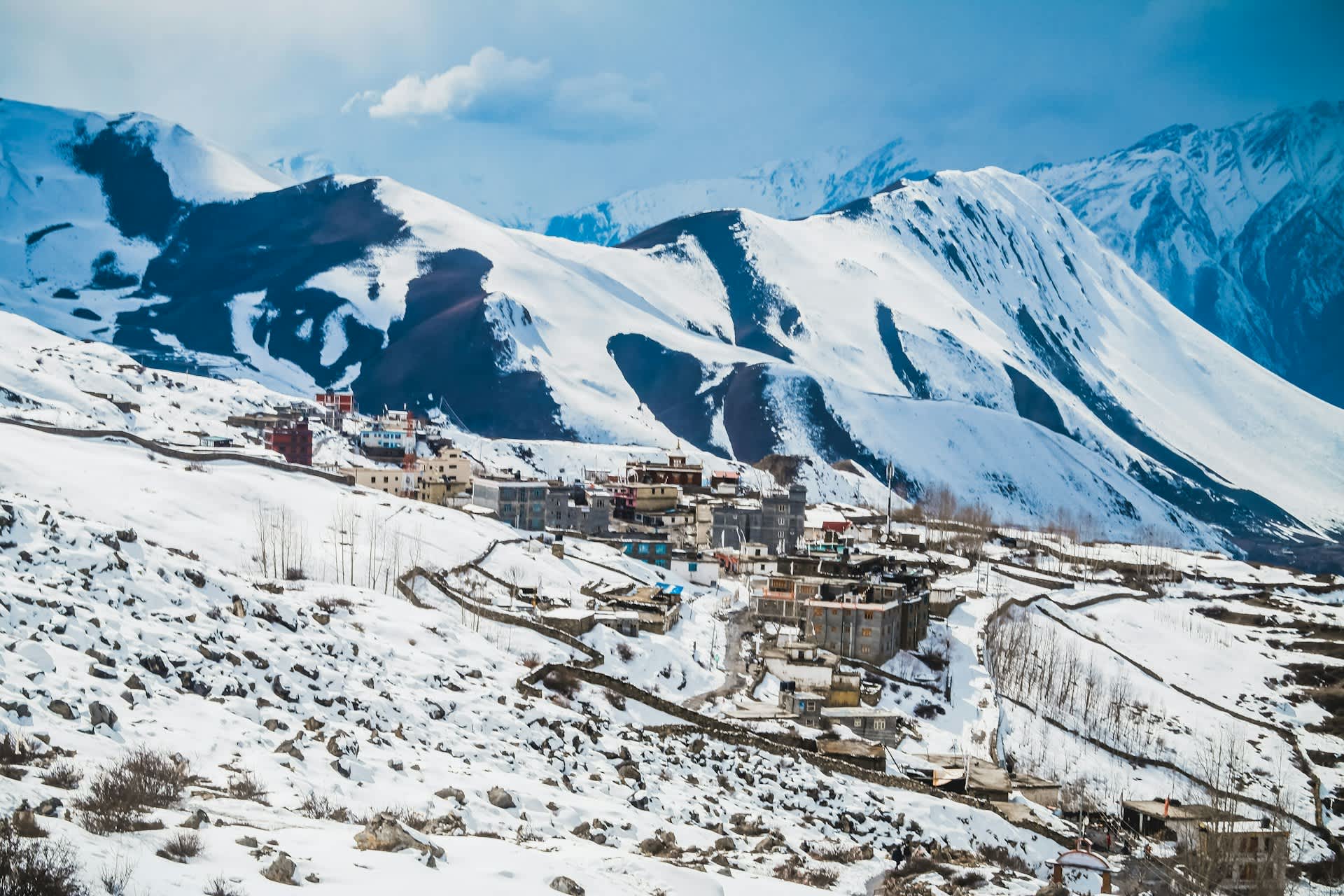
Along the way, the itinerary passes through Jomsom, the administrative center of Mustang and a common overnight stop, and Kagbeni, a walled village marking the entrance to Upper Mustang. From either point, a short jeep ride or a half-day walk reaches Muktinath Temple itself.
Because of the altitude gain, the itinerary includes a gradual approach rather than a same-day round trip from Pokhara, allowing time to adjust and reducing the risk of altitude-related discomfort.
Why Choose This 7-Day Muktinath Tour Nepal
- Road access is used deliberately — the jeep route via Jomsom avoids the multi-day trekking commitment of the classic Annapurna Circuit while still reaching Muktinath directly.
- Built-in altitude pacing — the itinerary does not attempt Pokhara-to-Muktinath in a single day, which reduces strain on travelers unfamiliar with altitude.
- Covers the Kali Gandaki Valley properly — Jomsom, Kagbeni, and Marpha are included as stops, not just passed through.
- Private vehicle throughout the mountain sections, avoiding dependence on shared jeep schedules that can add delays on this route.
- Local operator with direct road experience — Trek Trove Nepal manages permits, road conditions, and accommodation bookings directly in Mustang.
Muktinath Pilgrimage Significance
Muktinath is regarded by Hindus as one of the 108 Divyadesams associated with Vishnu and is linked in Hindu tradition to Shaligram stones — black ammonite fossils found in the Kali Gandaki riverbed and used in Vishnu worship. The temple complex includes 108 water spouts where pilgrims traditionally bathe, and the Jwala Mai Temple nearby, known for a naturally occurring flame associated with a spring.
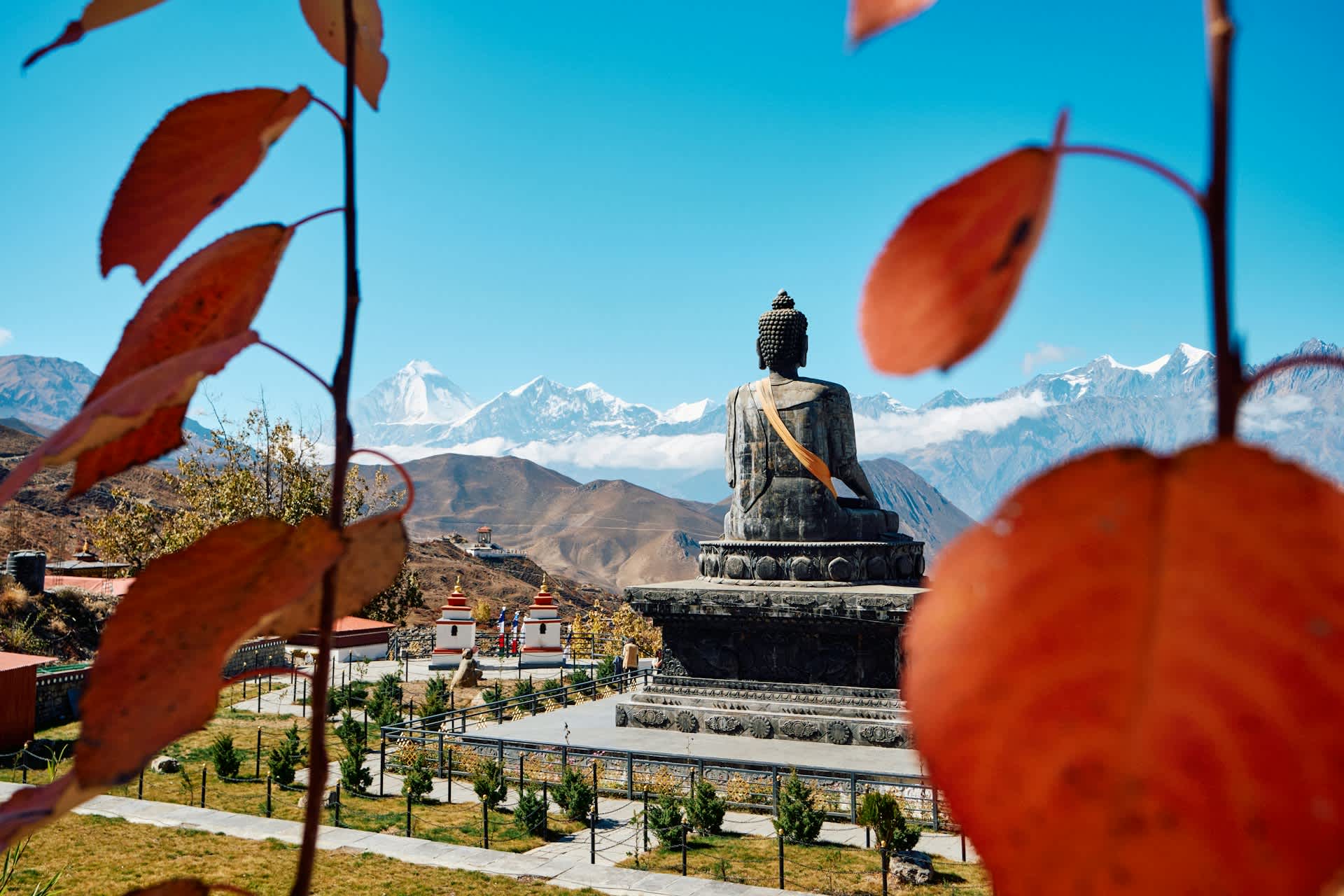
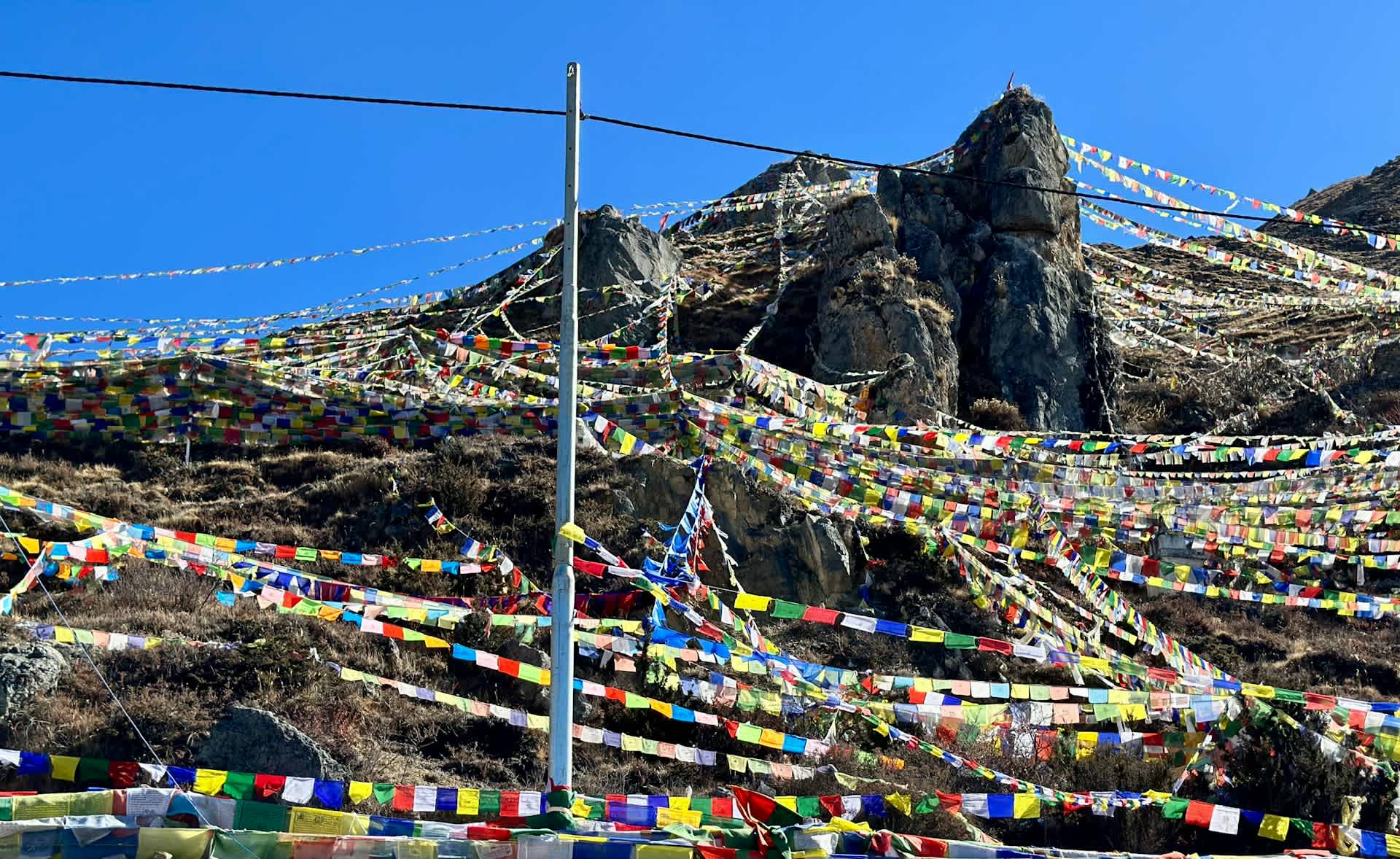
For Tibetan Buddhists, the site is known as Chumig Gyatsa and is associated with Guru Rinpoche (Padmasambhava), who is traditionally believed to have passed through the area. Buddhist monasteries and prayer flags are present at and around the temple complex alongside the Hindu shrine, and Buddhist pilgrims visit the same site as part of their own tradition. Trek Trove Nepal presents both traditions as they are commonly understood locally, without asserting the historical accuracy of any specific religious claim.
Nepal Muktinath Tour 7-Day Itinerary
Day 1: Arrival in Kathmandu
Arrival at Tribhuvan International Airport, transfer to hotel, and a trip briefing covering the road route, altitude considerations, and packing requirements for the days ahead.
Day 2: Kathmandu to Pokhara
Drive or domestic flight from Kathmandu to Pokhara (drive approximately 6–7 hours; flight approximately 25 minutes). Afternoon free by Phewa Lake, with time to prepare for the mountain road sections ahead.
Day 3: Pokhara to Jomsom to Kagbeni
Early departure by jeep from Pokhara, following the Kali Gandaki Valley road through Beni and Tatopani toward Jomsom (approximately 7–8 hours depending on road conditions). Continue by jeep to Kagbeni for the overnight stop, gaining altitude gradually.
Day 4: Kagbeni to Muktinath and Back to Jomsom
Morning jeep ride from Kagbeni to Muktinath (roughly 1–1.5 hours). Visit the temple complex, the 108 water spouts, and Jwala Mai Temple, with time for personal prayer or reflection. Return by jeep to Jomsom for the overnight stay.
Day 5: Jomsom to Pokhara
Return journey to Pokhara by jeep along the same valley road, or by short domestic flight from Jomsom to Pokhara where flight schedules allow (subject to weather, as Jomsom flights are frequently affected by wind conditions later in the day). Overnight in Pokhara.
Day 6: Pokhara – Free Day / Sightseeing
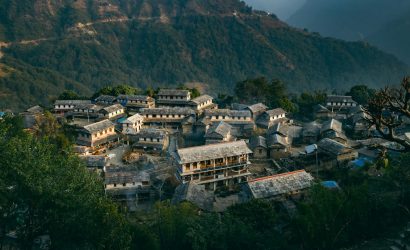
A buffer day in Pokhara, used either as a rest day or for optional sightseeing around Phewa Lake, Davis Falls, or the World Peace Pagoda. This day also functions as a schedule buffer in case Day 3 or Day 5 road/flight conditions caused delays.
Day 7: Pokhara to Kathmandu and Departure
Drive or flight back to Kathmandu, followed by international departure or free time depending on flight schedule.
Route Overview
| Segment | Distance/Duration (approx.) | Mode |
|---|---|---|
| Kathmandu – Pokhara | 200 km / 6–7 hrs (or 25 min flight) | Private vehicle or flight |
| Pokhara – Jomsom | 8–9 hrs by jeep on mountain road | Private jeep |
| Jomsom – Kagbeni | 1 hr by jeep | Private jeep |
| Kagbeni – Muktinath | 1–1.5 hrs by jeep | Private jeep |
| Jomsom – Pokhara (return) | 20 min flight or 8–9 hrs by jeep | Domestic flight or jeep |
Daily Travel and Sightseeing Table
| Day | Route | Key Stops | Altitude Change |
|---|---|---|---|
| 1 | Arrival Kathmandu | Orientation | ~1,400 m |
| 2 | Kathmandu → Pokhara | Phewa Lake | ~820 m |
| 3 | Pokhara → Jomsom → Kagbeni | Beni, Tatopani, Marpha | ~820 m → ~2,800 m |
| 4 | Kagbeni → Muktinath → Jomsom | Muktinath Temple, 108 water spouts | ~2,800 m → ~3,800 m → ~2,700 m |
| 5 | Jomsom → Pokhara | — | ~2,700 m → ~820 m |
| 6 | Pokhara (free day) | Optional sightseeing | ~820 m |
| 7 | Pokhara → Kathmandu | Departure | ~1,400 m |
Altitude Information
Muktinath sits at approximately 3,800 meters, which is high enough to cause mild altitude symptoms in some travelers — typically headache, mild breathlessness, or fatigue — even though the tour does not reach altitudes associated with serious altitude sickness risk. Because the jeep route gains altitude faster than a trekking itinerary would, travelers are advised to stay hydrated, avoid alcohol on Day 3 and Day 4, and inform the guide immediately if they feel unwell.
The itinerary includes an overnight stop in Kagbeni (around 2,800 m) before continuing to Muktinath the next morning, which helps with acclimatization compared to a same-day round trip from Pokhara.
Transportation Details
- Kathmandu–Pokhara: private vehicle or domestic flight, traveler’s choice.
- Pokhara–Jomsom–Muktinath–Jomsom–Pokhara: private 4WD jeep, required due to the unpaved and mountainous sections of this road.
- Jomsom–Pokhara return flight: available as an alternative to the return jeep drive, subject to weather-related delays or cancellations common on this specific route, particularly in the afternoon when winds pick up in the valley.
- All road transport uses private vehicles rather than shared jeeps, reducing dependency on public departure schedules.
Muktinath Temple Visit
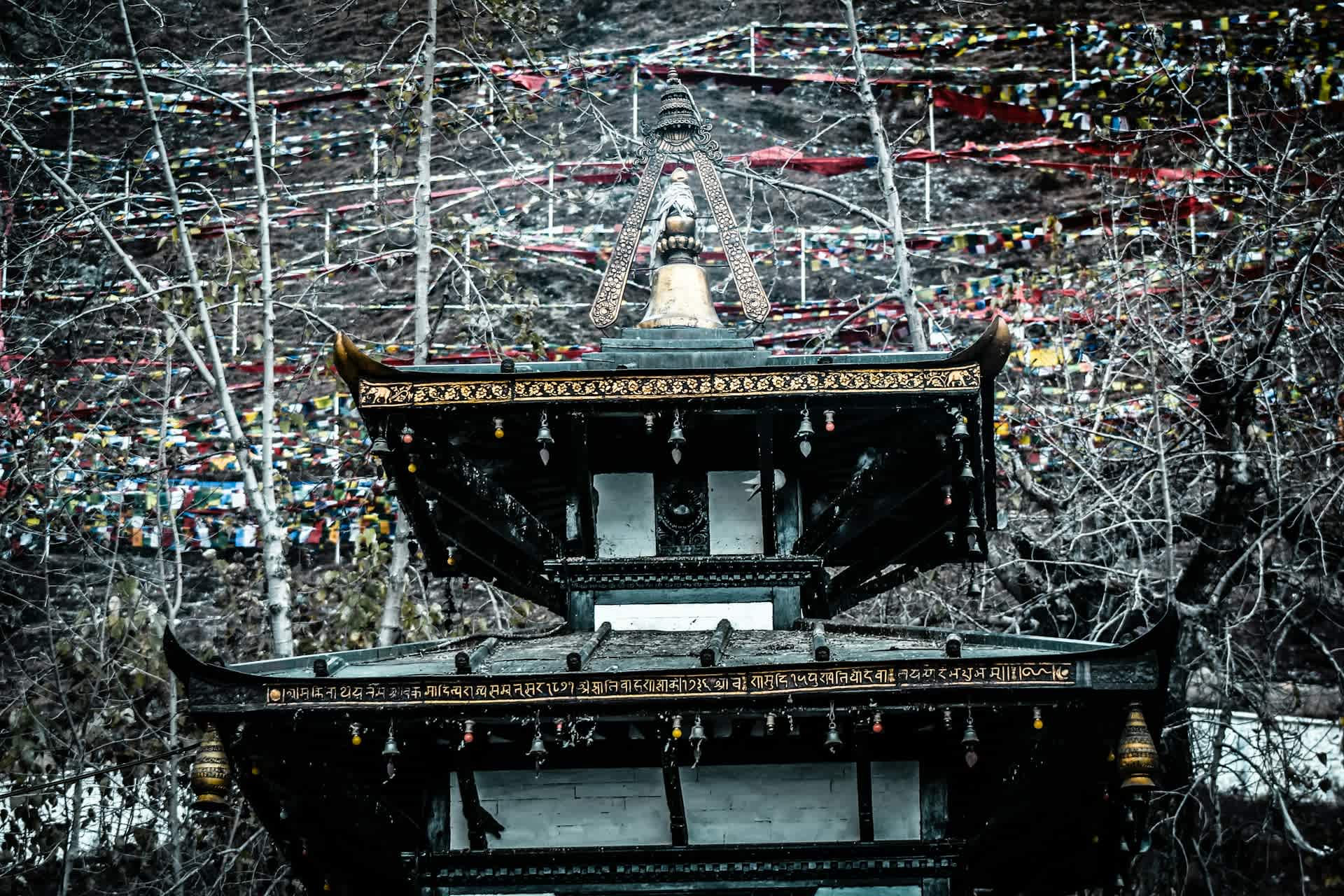
The Muktinath Temple complex includes the main pagoda-style temple dedicated to Vishnu, the row of 108 water spouts where pilgrims traditionally take a ritual bath, and the adjacent Jwala Mai Temple. Visitors typically spend two to three hours at the complex, including walking time between the different shrine areas. The site is open to visitors of all faiths, though appropriate conduct and modest dress are expected inside the temple buildings.
108 Water Spouts and Jwala Mai
The 108 stone water spouts, shaped as bull heads, run along a wall behind the main temple and are fed by natural spring water. Pilgrims commonly walk the length of the spouts, and some choose to bathe under them despite the cold water temperature, particularly outside the winter months. The Jwala Mai Temple, close to the main shrine, is known for a natural flame associated with a spring at the site — a feature that holds significance in both Hindu and Buddhist tradition, though the exact geological explanation for the flame is not something Trek Trove Nepal will speculate on here.
Hindu and Buddhist Significance
Muktinath is unusual among pilgrimage sites in Nepal because it is actively used by both Hindu and Buddhist pilgrims, often on the same day. Hindu visitors associate the site with Vishnu and with liberation (moksha), reflected in the name Muktinath. Tibetan Buddhist visitors know the site as Chumig Gyatsa and associate it with Guru Rinpoche. Guides accompanying this tour will explain both traditions as they are commonly practiced and understood locally, and travelers of any background, or no religious background, are welcome to visit respectfully.
Best Time to Visit Muktinath
March to May and September to November are generally the most reliable periods for this route, with clearer mountain views and more stable domestic flight schedules between Jomsom and Pokhara. Winter (December–February) brings cold temperatures at Muktinath and possible snow on higher sections of the road, though the route generally remains passable. The monsoon season (June–August) carries a higher risk of landslides on the Beni–Jomsom road and reduced visibility, which can affect both driving conditions and flight reliability.
Season Comparison Table
| Season | Months | Road Conditions | Flight Reliability (Jomsom) |
|---|---|---|---|
| Spring | Mar–May | Generally clear | Good, some afternoon wind delays |
| Summer/Monsoon | Jun–Aug | Higher landslide risk | Frequently disrupted |
| Autumn | Sep–Nov | Clear, stable | Good |
| Winter | Dec–Feb | Cold, occasional snow at altitude | Variable |
Muktinath Weather
Temperatures at Muktinath are noticeably cooler than in Kathmandu or Pokhara due to the altitude. Daytime temperatures in spring and autumn are typically mild, while mornings and evenings are cold. Winter can bring temperatures well below freezing overnight. Wind is a regular feature of the Kali Gandaki Valley, particularly from late morning onward, which is one of the reasons early departures are built into Day 4.
Accommodation
| Location | Nights | Accommodation Type |
|---|---|---|
| Kathmandu | 2 | 2–3 star hotel |
| Pokhara | 2 | 2–3 star hotel |
| Kagbeni | 1 | Local guesthouse |
| Jomsom | 1 | Local guesthouse/lodge |
Accommodation in Kathmandu and Pokhara is standard hotel-level, with private rooms and attached bathrooms. In Kagbeni and Jomsom, accommodation is at mountain guesthouses — comfortable but simpler than city hotels, with hot showers typically available (sometimes for a small additional charge) and heating usually limited to common dining areas rather than individual rooms.
Meals
Breakfast is included daily throughout the trip. Lunch and dinner are included specifically on the mountain sections of the itinerary (Days 3 and 4), where guesthouse dining is the practical option given limited alternatives in Kagbeni and Jomsom. Meals in Kathmandu and Pokhara are left flexible so travelers can choose from the wider range of restaurants available in those cities.
Guide and Local Assistance
An experienced guide familiar with the Mustang road route, altitude management, and both Hindu and Buddhist customs at Muktinath accompanies the group from Pokhara onward. The guide coordinates jeep logistics, guesthouse check-ins, and temple visit timing, and is available to answer questions about the religious practices observed at the site.
Road and Travel Conditions
The Beni–Jomsom–Muktinath road is unpaved for significant sections and can be affected by dust, loose gravel, and occasional landslide debris, particularly in the monsoon season. Travel times can extend beyond estimates if road conditions require slower driving. Private 4WD jeeps are used specifically because standard vehicles are not well suited to this route. Travelers with back or joint sensitivity should be aware that the ride, while manageable, is not the smooth experience of highway travel.
Who Is This Tour Suitable For?
- Hindu and Buddhist pilgrims seeking direct temple access without a multi-day trek
- Travelers interested in the Kali Gandaki Valley and Mustang region generally
- Families with teenagers or adults comfortable with several hours of jeep travel per day
- Travelers in reasonable general health who are not significantly affected by moderate altitude
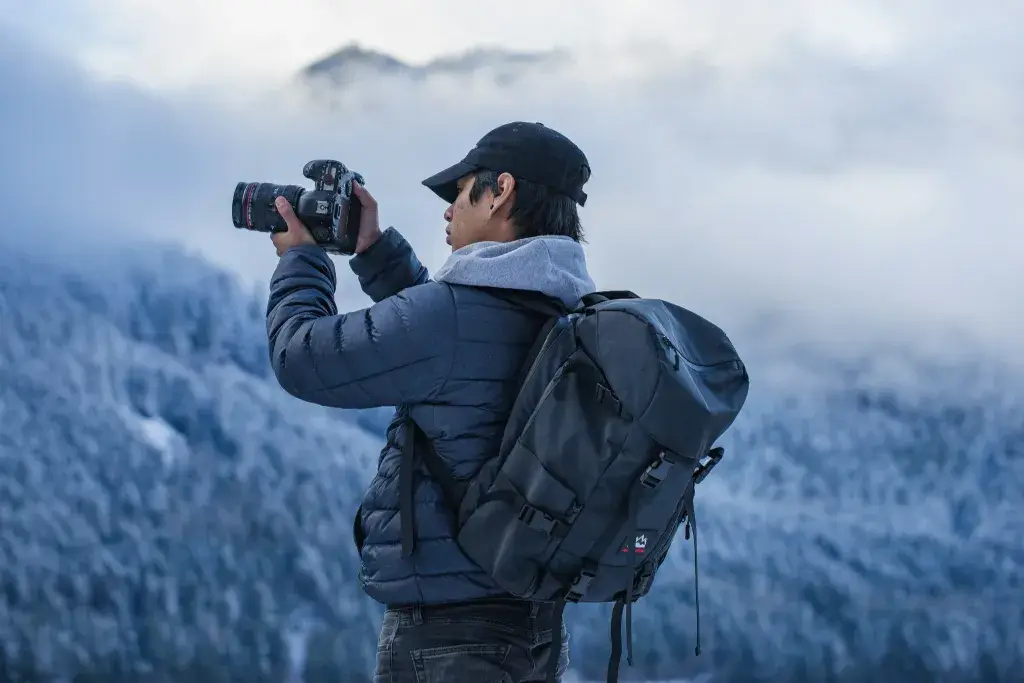
- Photographers interested in Himalayan landscapes and Mustang’s Tibetan-influenced villages
This itinerary is not designed as a trekking package. Travelers wanting to walk sections of the Annapurna Circuit or Upper Mustang should ask about Trek Trove Nepal’s separate trekking itineraries.
Accessibility and Walking Requirements
Walking requirements are light — mainly short distances within Jomsom, Kagbeni, and around the Muktinath temple complex itself, plus stairs and uneven ground at the temple site. The main physical demand is tolerating several consecutive hours of jeep travel on unpaved mountain roads rather than sustained walking or hiking.
Packing Checklist Table
| Category | Items |
|---|---|
| Clothing | Warm layers, windproof jacket, comfortable trousers |
| Footwear | Sturdy walking shoes, easily removable footwear for temple visits |
| Health | Personal medication, basic altitude discomfort remedies, sunscreen |
| Accessories | Sunglasses, hat, gloves (cooler months), reusable water bottle |
| Documents | Passport, permits (arranged by Trek Trove Nepal), travel insurance details |
| Extras | Power bank, cash in Nepali rupees (limited ATM access in Mustang) |
Temple and Religious Etiquette
- Remove shoes before entering shrine buildings at the Muktinath complex.
- Dress modestly, particularly when entering the main temple.
- Ask before photographing the interior of shrine buildings or Jwala Mai Temple.
- Move around the temple area calmly and avoid loud conversation near active prayer or ritual activity.
- Bathing under the 108 water spouts is optional and entirely at the traveler’s discretion — the water is cold year-round.
Cost Breakdown
Pricing depends on group size, vehicle type, choice of Jomsom–Pokhara flight versus jeep return, and accommodation category. The figures below are illustrative; contact Trek Trove Nepal for a confirmed quote based on your dates and group size.
| Group Size | Approx. Price per Person (USD) |
|---|---|
| Solo traveler | Highest per-person rate (single supplement applies) |
| 2 people | Reduced per-person rate |
| 4–6 people | Further reduced per-person rate |
| 7+ people | Best per-person group rate |
Exact figures are confirmed at booking based on current jeep hire rates, flight availability, and season.
Optional Services
- Domestic flight upgrade for Kathmandu–Pokhara and/or Jomsom–Pokhara legs
- Extra night in Pokhara before or after the mountain sections
- Private car upgrade to a larger or more comfortable vehicle
- Extension to Upper Mustang (Lo Manthang) for travelers with additional time and the required restricted-area permit
Responsible Tourism
Trek Trove Nepal asks travelers to be mindful that Muktinath is an active pilgrimage site for both Hindu and Buddhist visitors, many of whom are there for personal religious reasons rather than sightseeing. This means respecting temple etiquette, minimizing disruption during prayer or ritual activity, and being conscious of water use and waste in the Mustang region, where infrastructure is more limited than in Kathmandu or Pokhara.
Ready to Plan Your Muktinath Tour?
If you’re planning a Muktinath Tour Nepal trip, Trek Trove Nepal can arrange the full 7-day itinerary — jeep transport, guesthouse and hotel bookings, permits, and guiding — based on your travel dates and group size. Contact Trek Trove Nepal to check current availability and receive a detailed quote for this Muktinath Tour Package.
Muktinath Tour Nepal Highlights
- Drive the Kali Gandaki Valley road between Beni and Jomsom, running beneath the Annapurna and Dhaulagiri massifs — one of the few places in the world where you pass between two 8,000-meter peaks on a single overland route.
- Bathe under (or simply walk past) the 108 water spouts at Muktinath Temple, a row of bull-head-shaped stone spouts fed by natural spring water, where pilgrims have performed ritual bathing for generations.
- See the natural flame at Jwala Mai Temple, a spring-fed site adjacent to the main shrine that holds significance in both Hindu and Buddhist tradition.
- Visit a site sacred to two religions at once — Hindu pilgrims worship Vishnu here as Muktinath, while Tibetan Buddhist pilgrims know the same site as Chumig Gyatsa, associated with Guru Rinpoche.
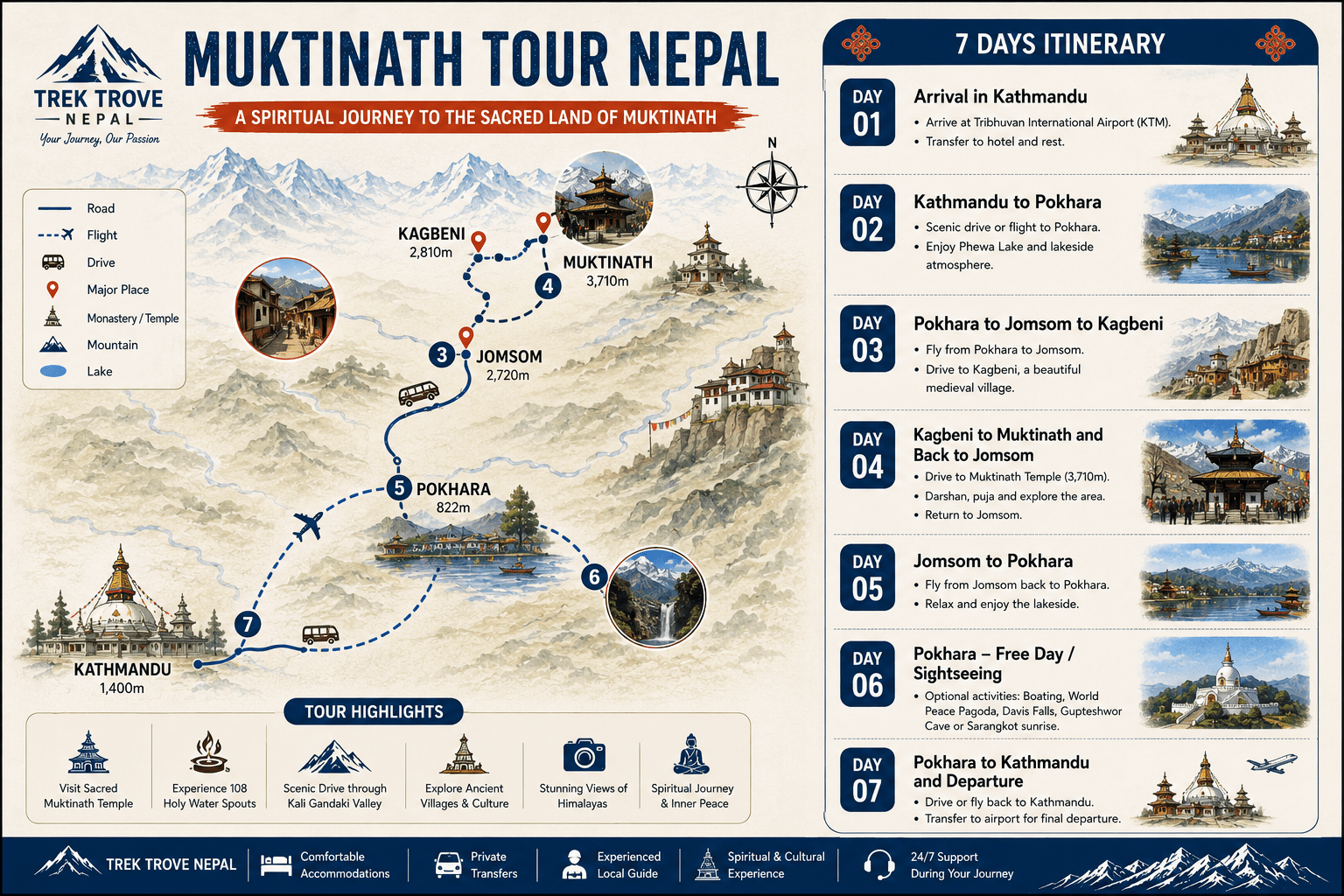
- Overnight in Kagbeni, a walled village marking the entrance to Upper Mustang, with narrow alleyways, chortens, and architecture shaped by centuries of Tibetan cultural influence.
- Stop in Marpha, known locally for apple orchards and traditional whitewashed stone houses, a contrast to the arid landscape surrounding it.
- Spot Shaligram stones in the Kali Gandaki riverbed — black ammonite fossils central to Vishnu worship in Hindu tradition, found almost nowhere else in comparable numbers.
- Reach 3,800 meters by jeep, not on foot — the tour covers the altitude and terrain of a high Himalayan pilgrimage without requiring the multi-day trekking commitment of routes like the Annapurna Circuit.
- Watch the landscape change dramatically in under two days — from Pokhara's green lake valley to Mustang's dry, wind-carved, Tibetan-influenced terrain.
- Build in a Pokhara buffer day on Day 6, giving the itinerary flexibility to absorb any road or flight delays from the Jomsom sections without disrupting the return to Kathmandu.